
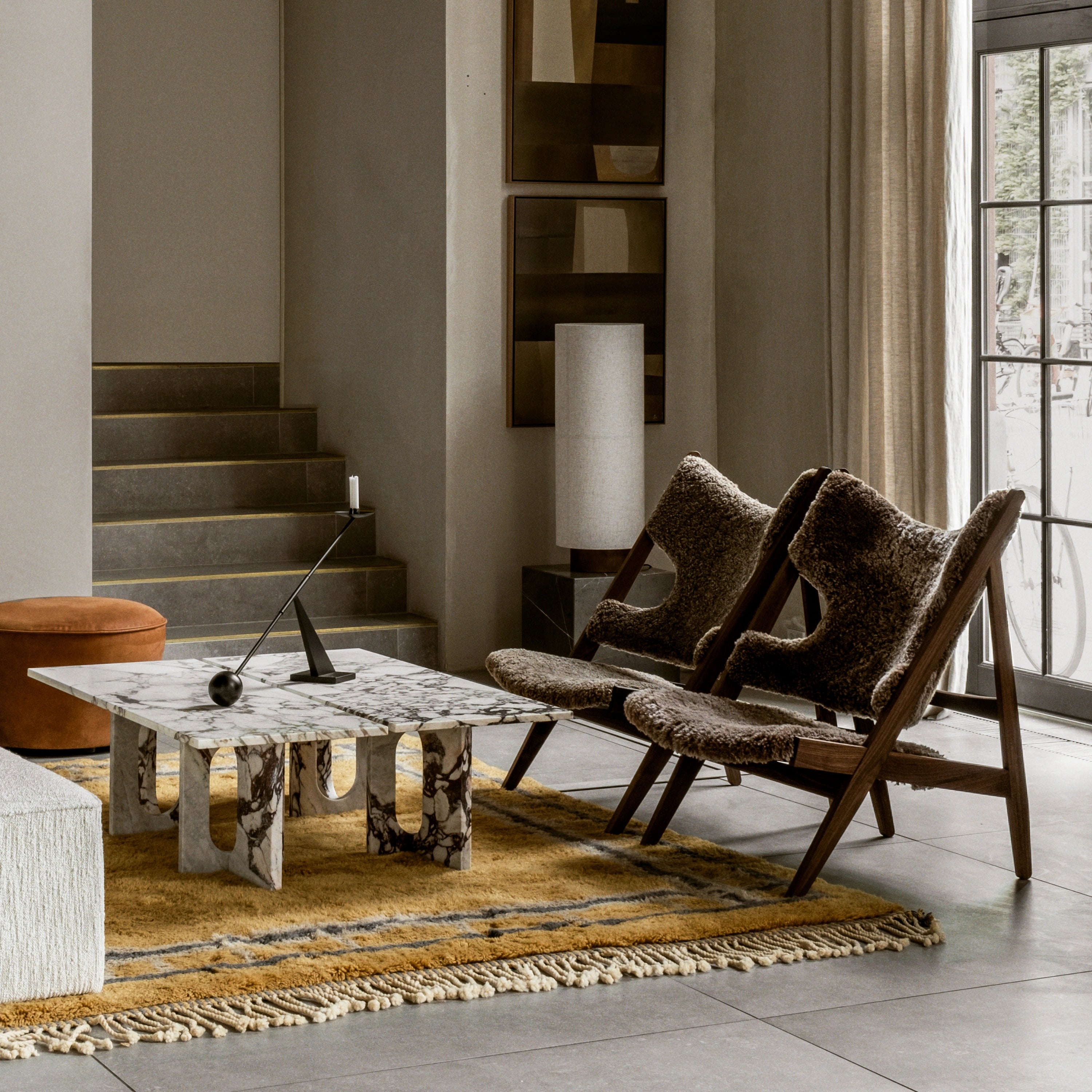
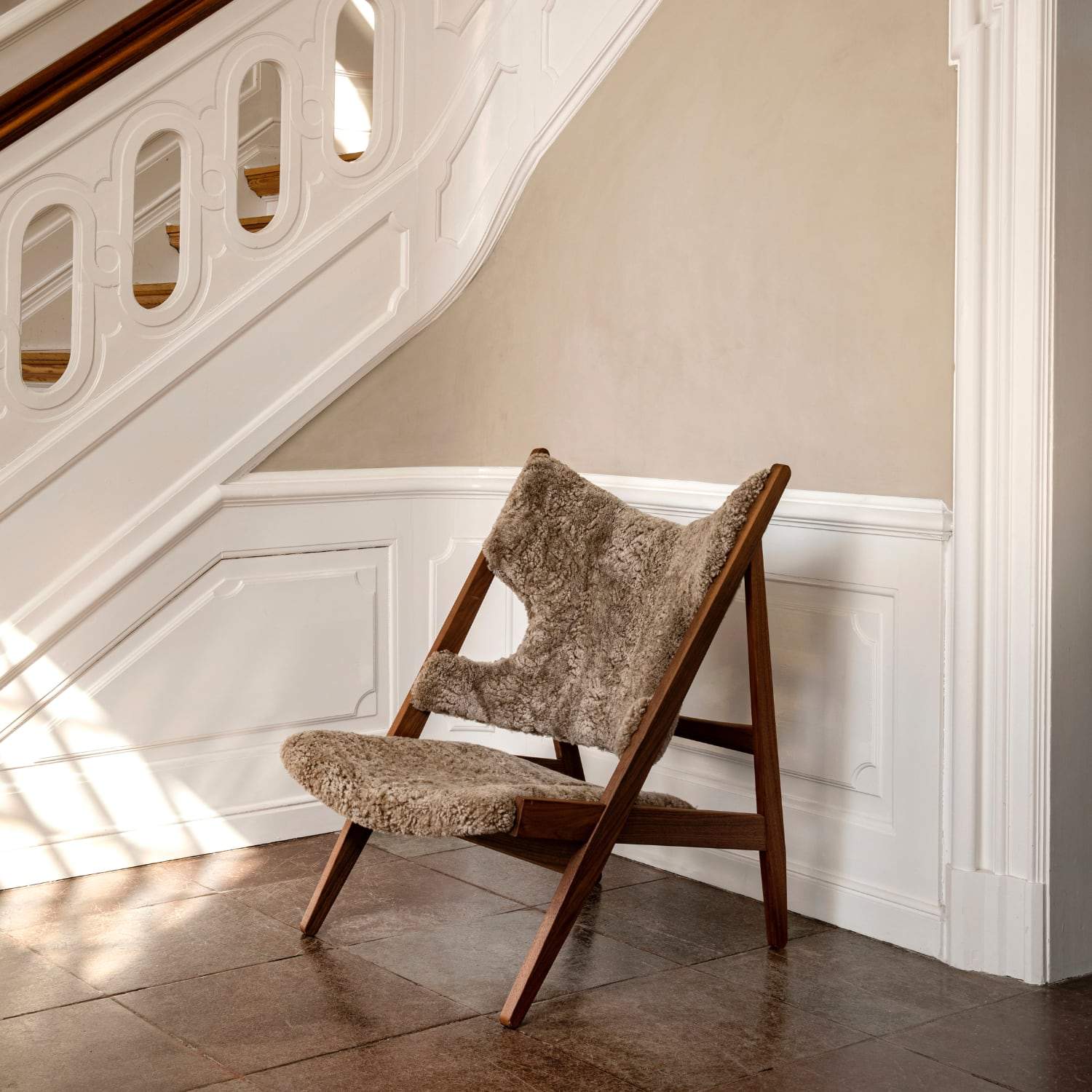
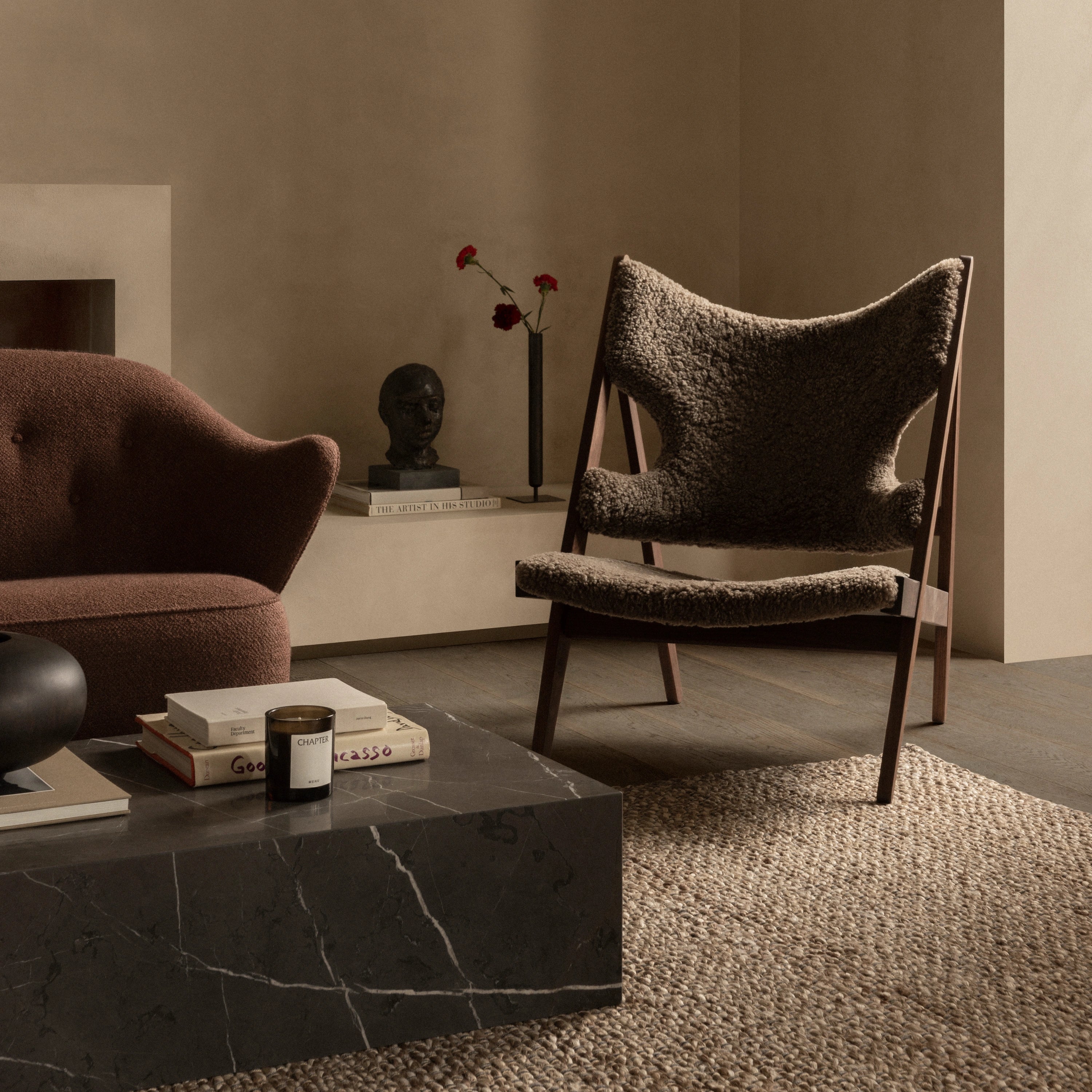
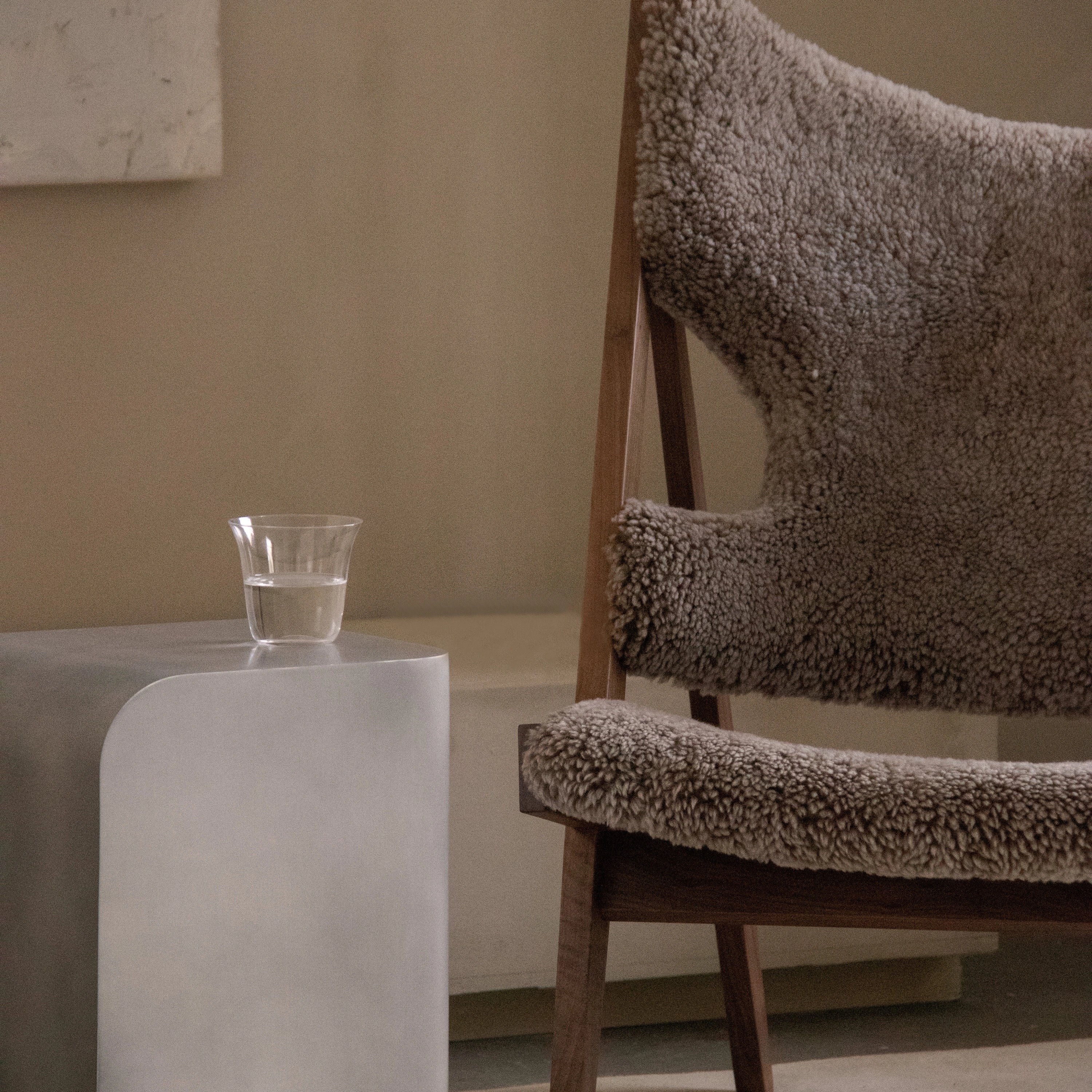
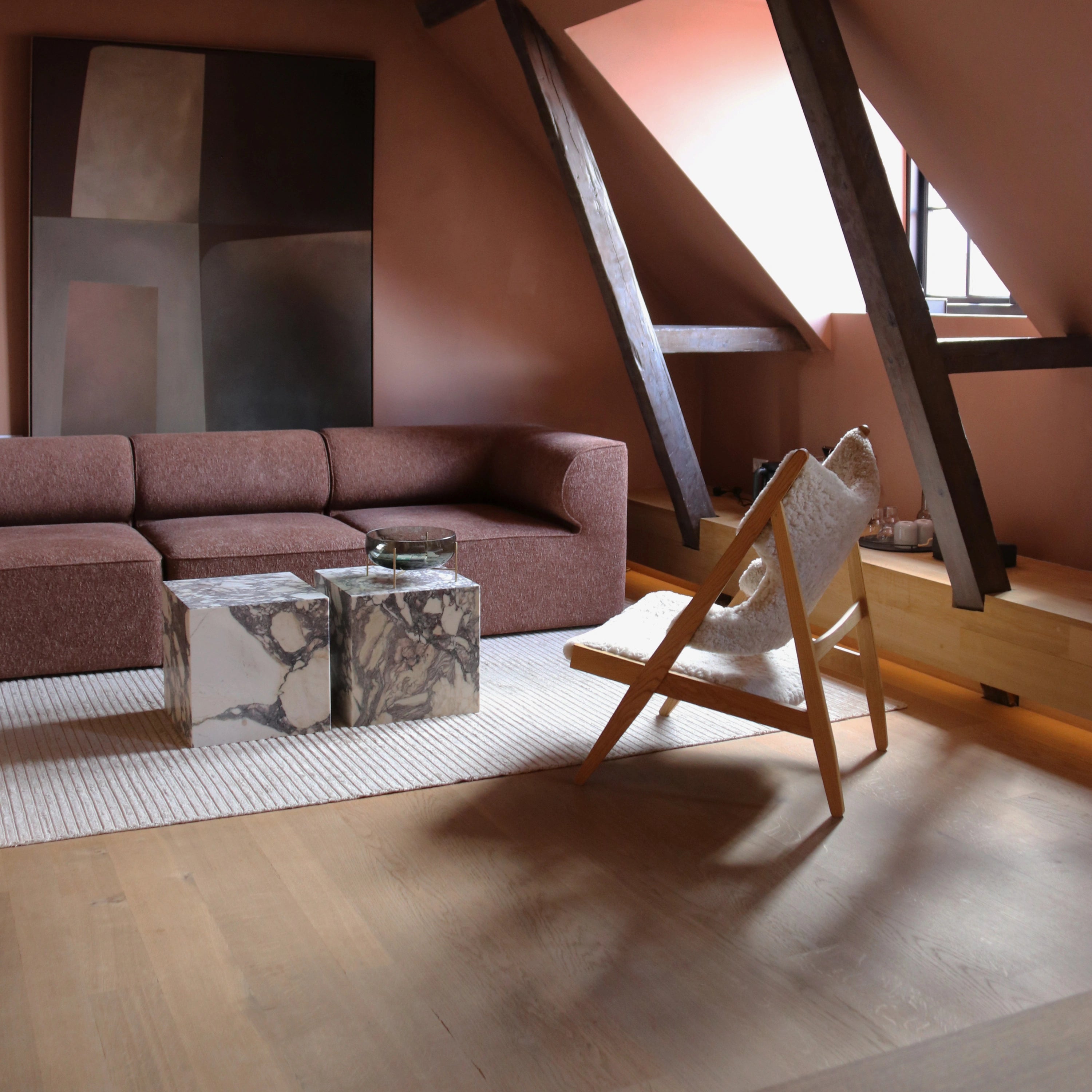
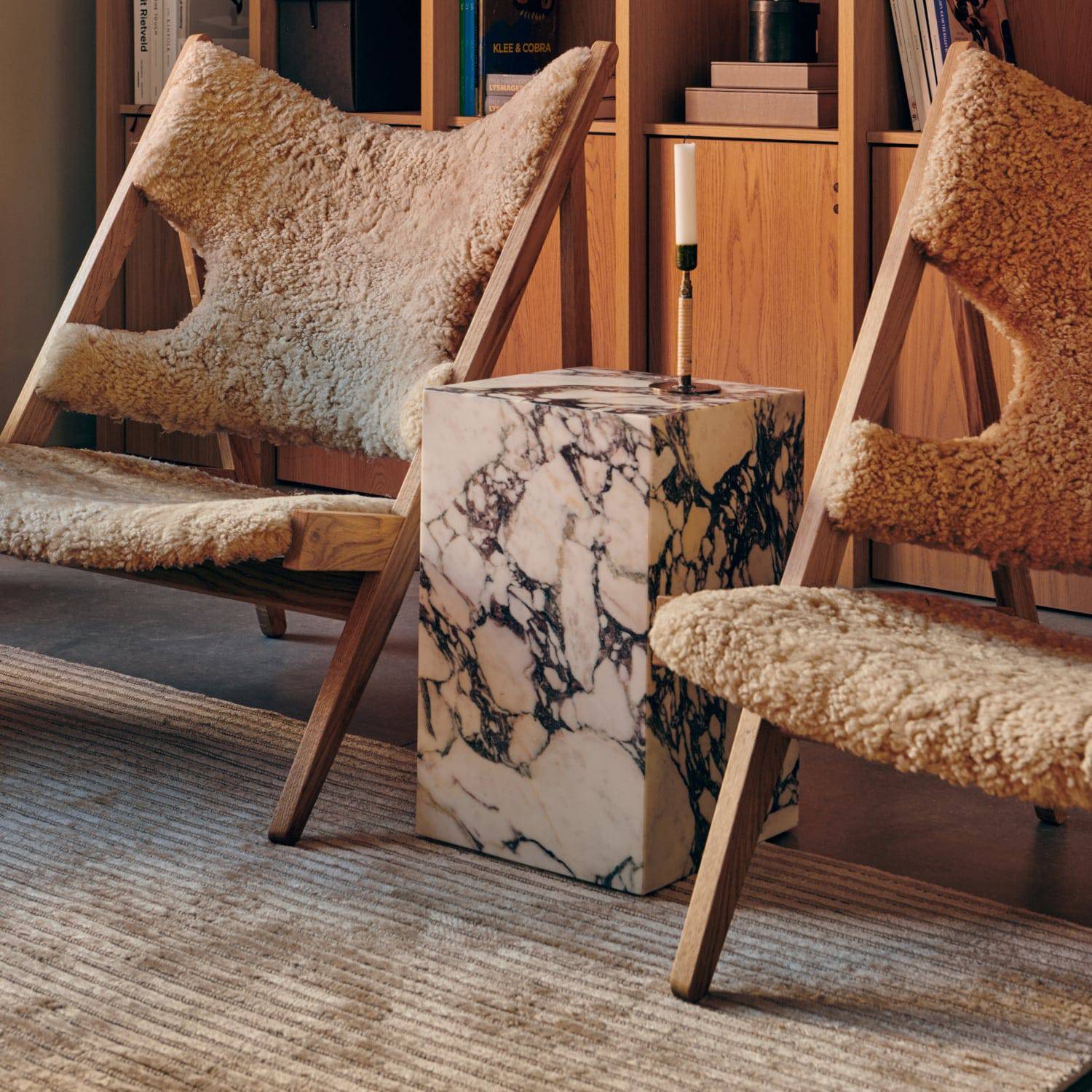
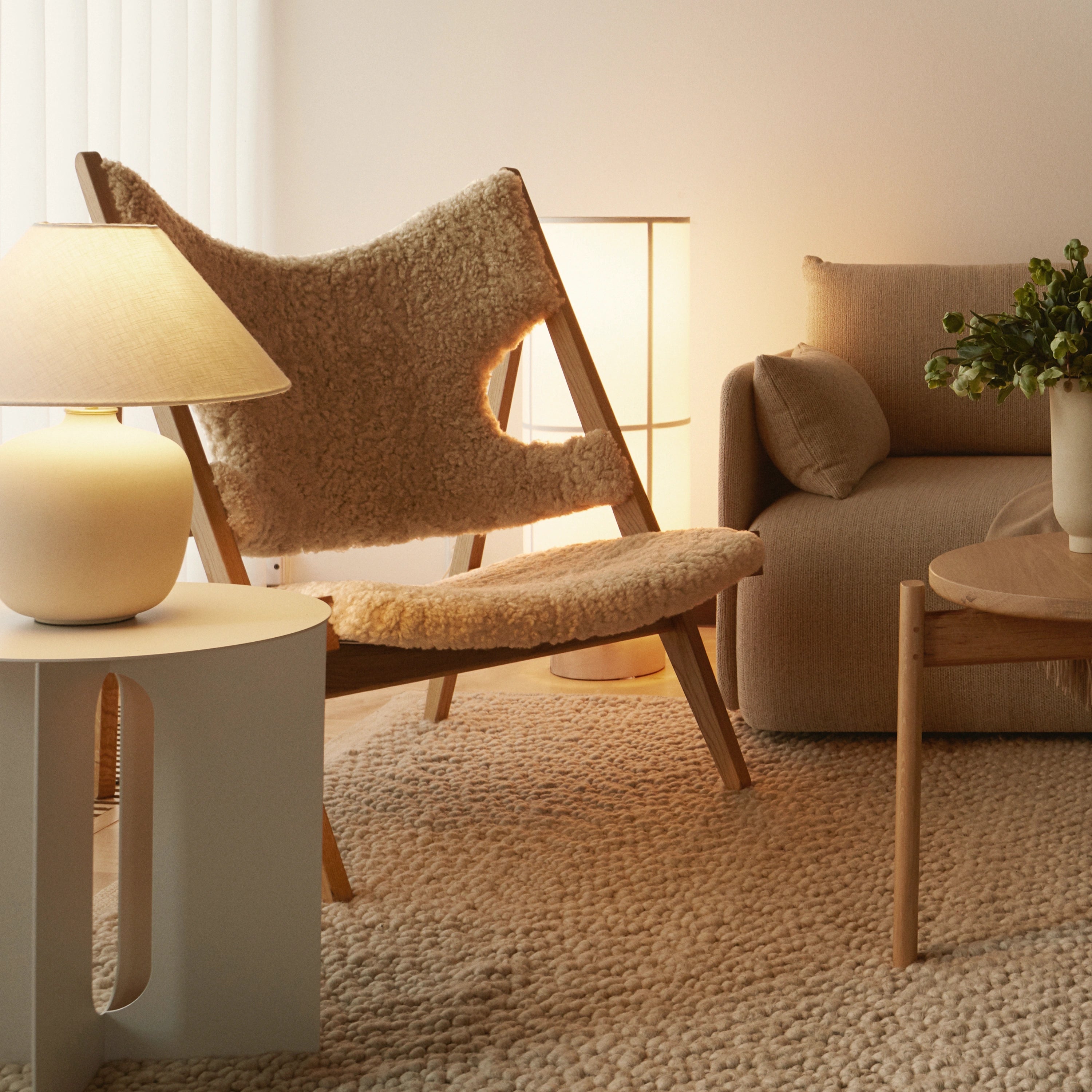
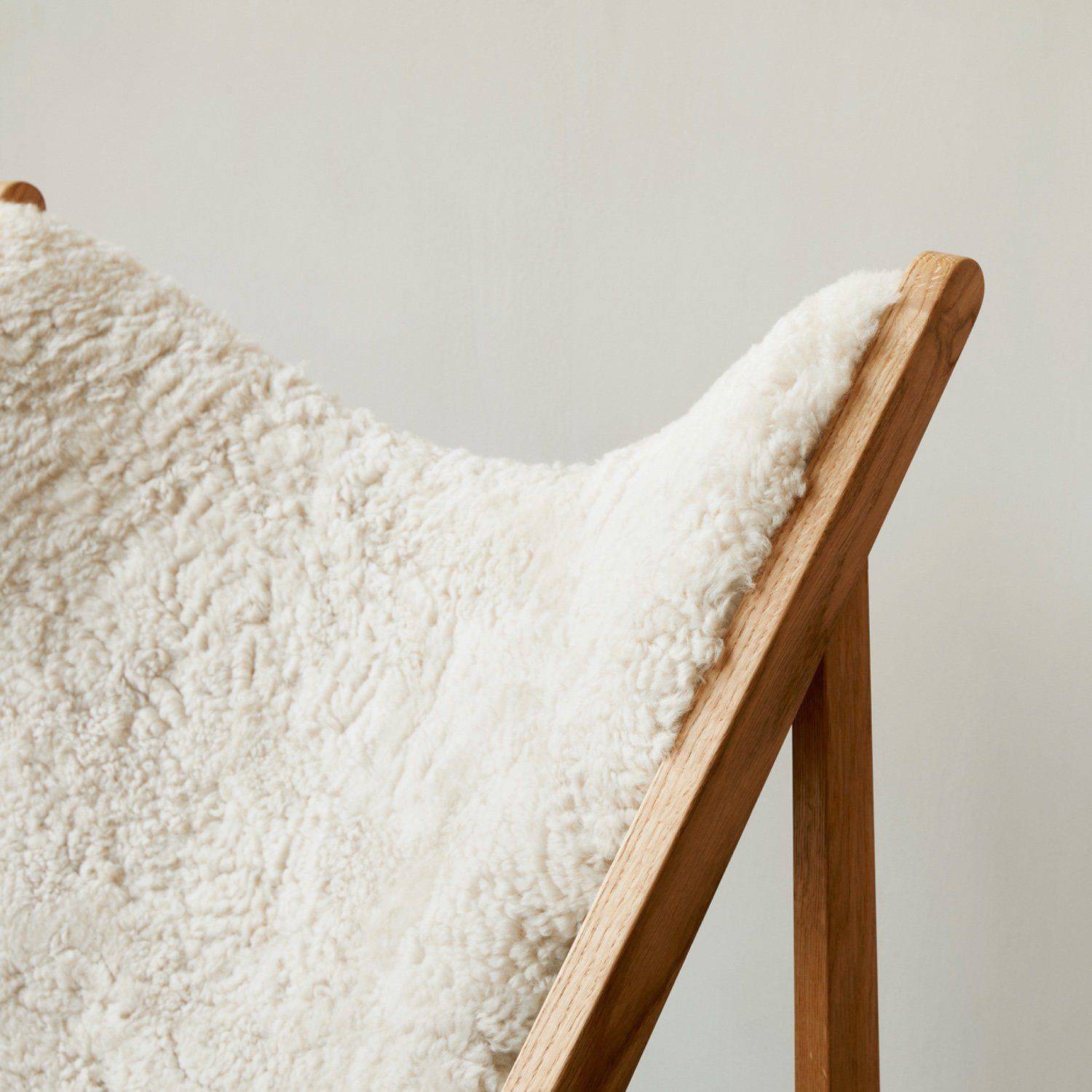
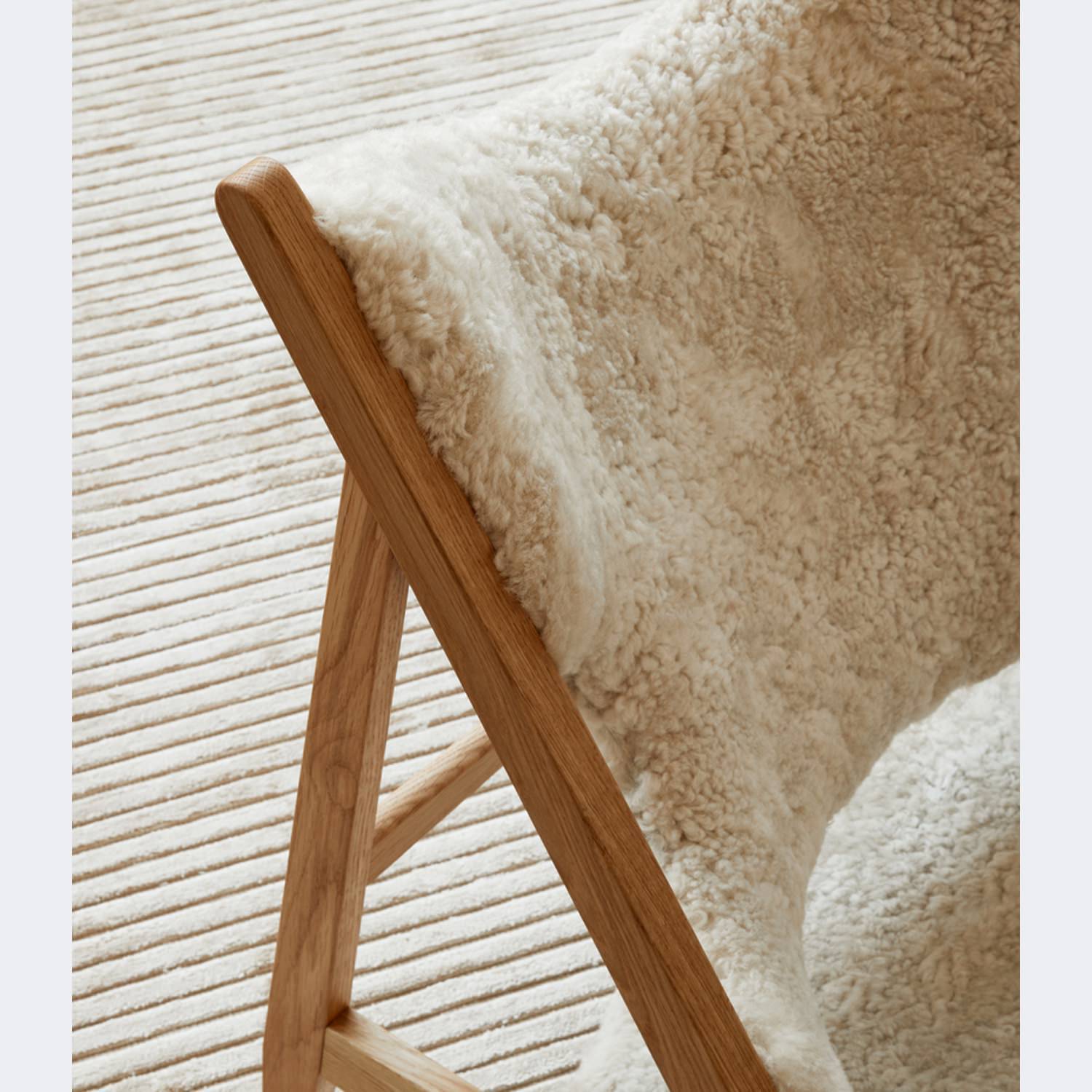
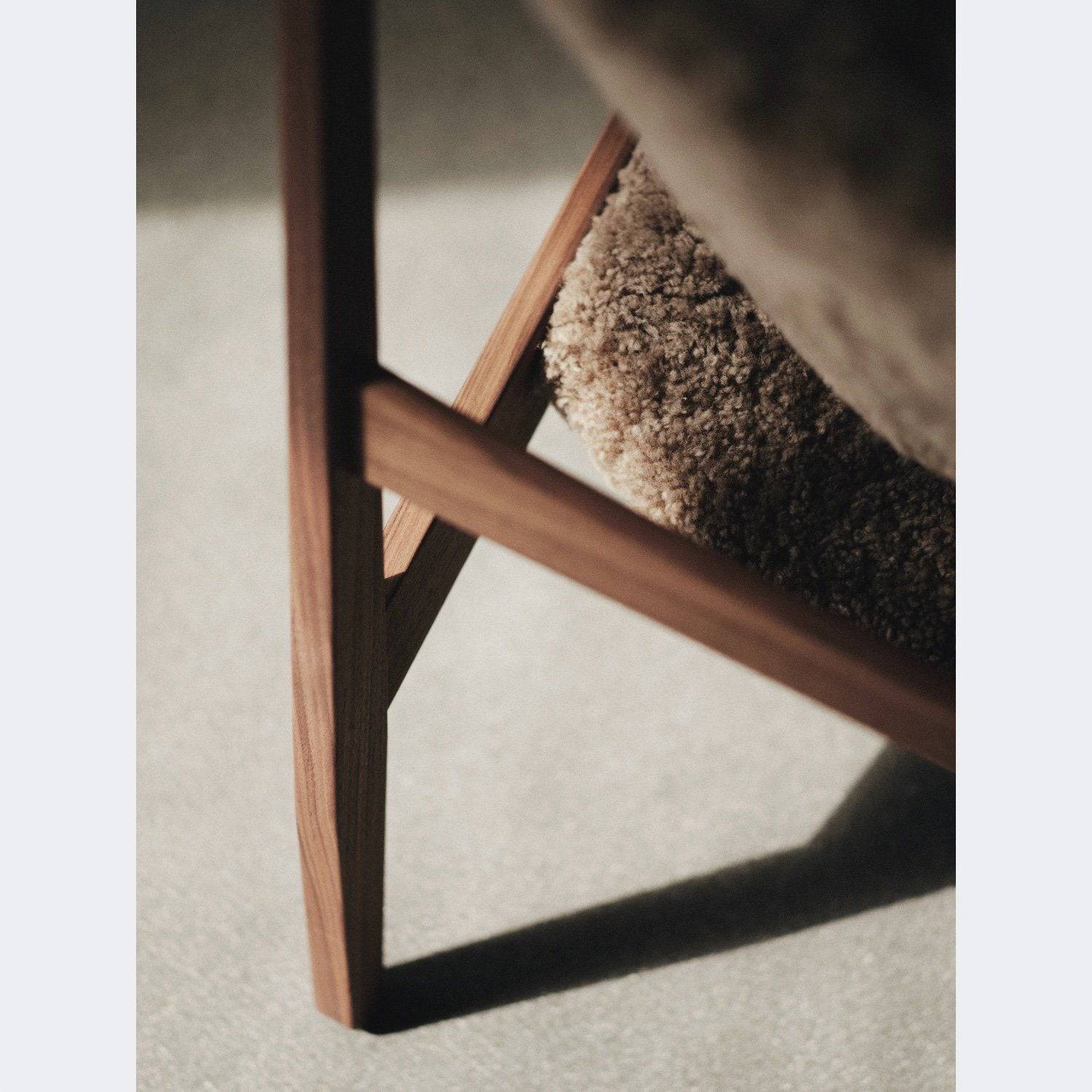
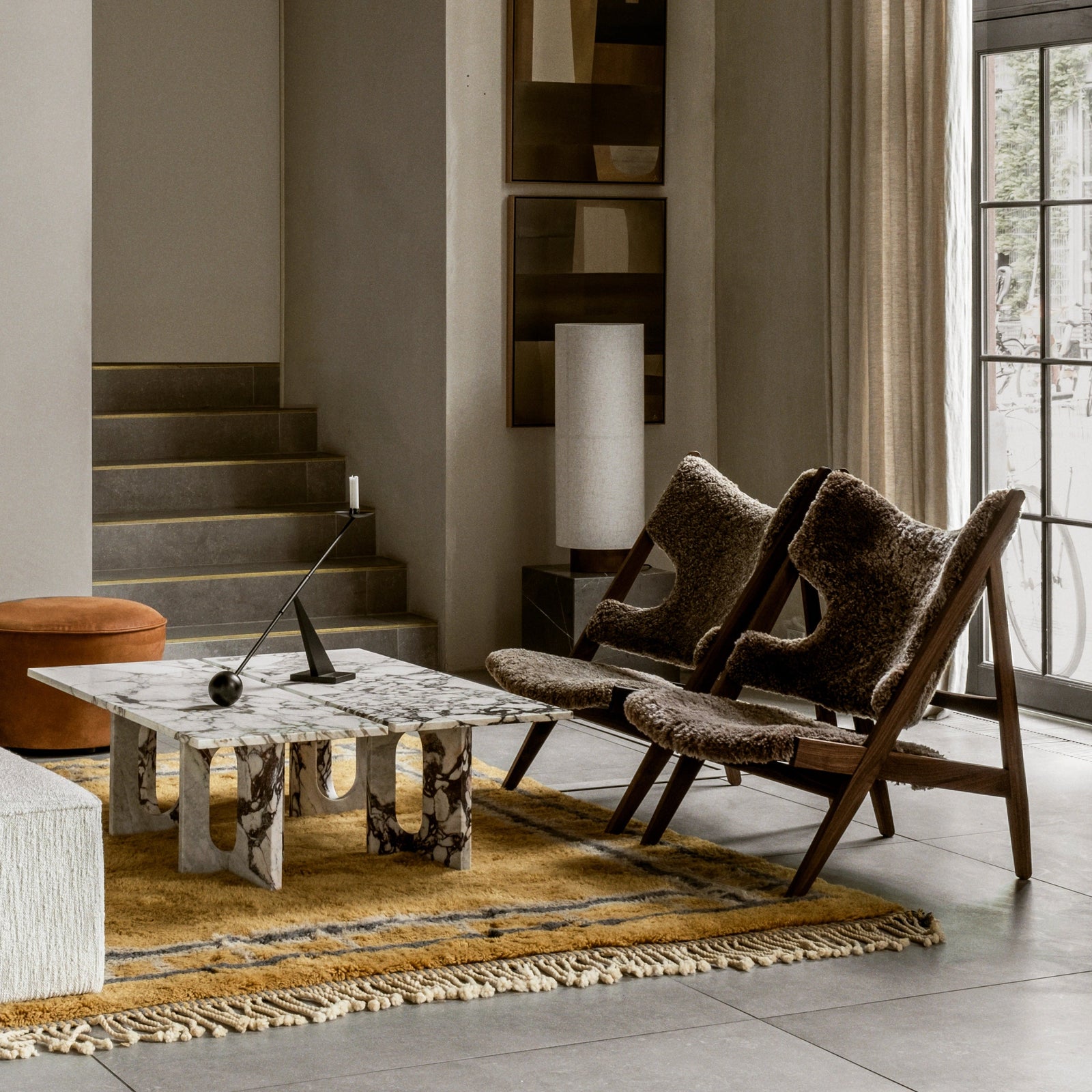
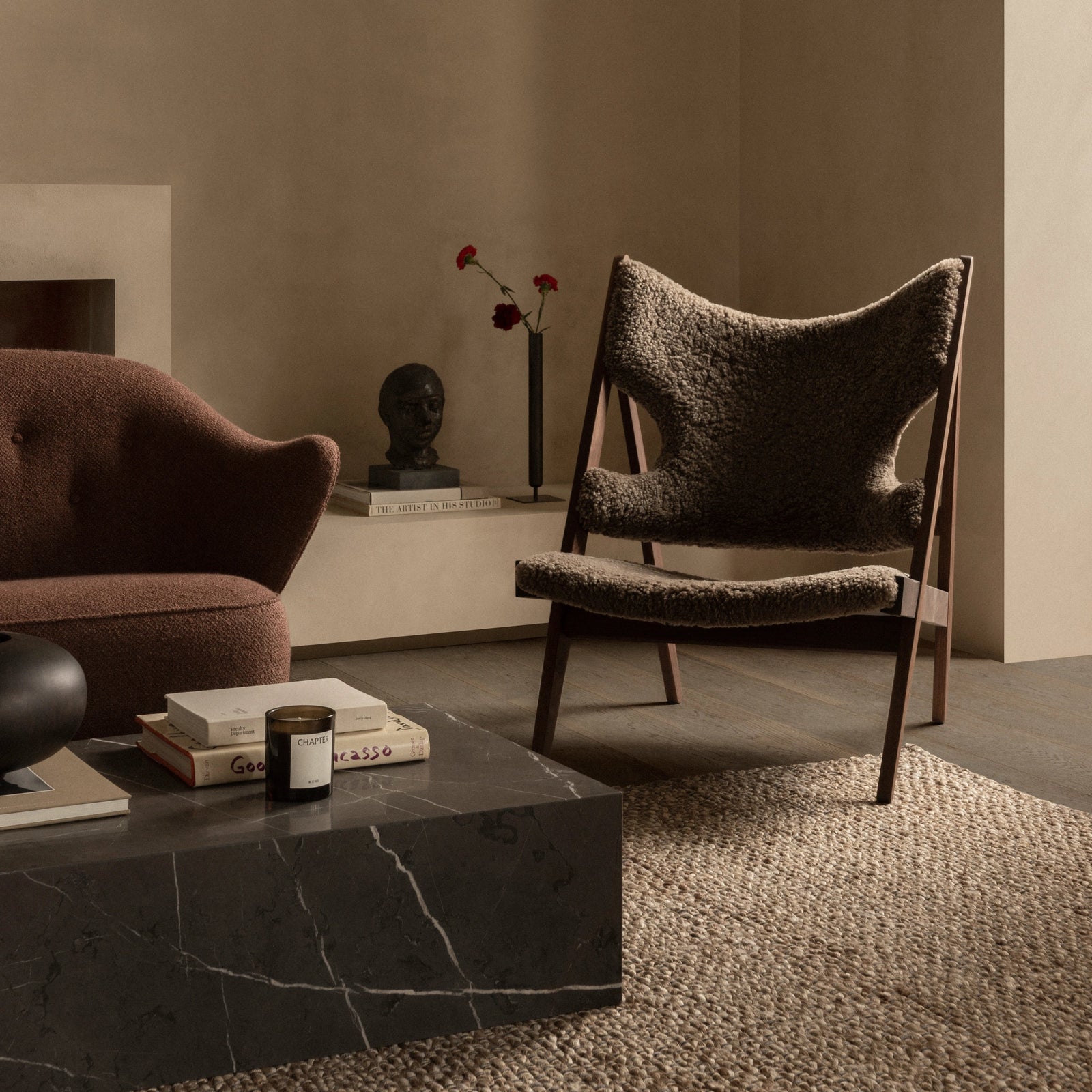
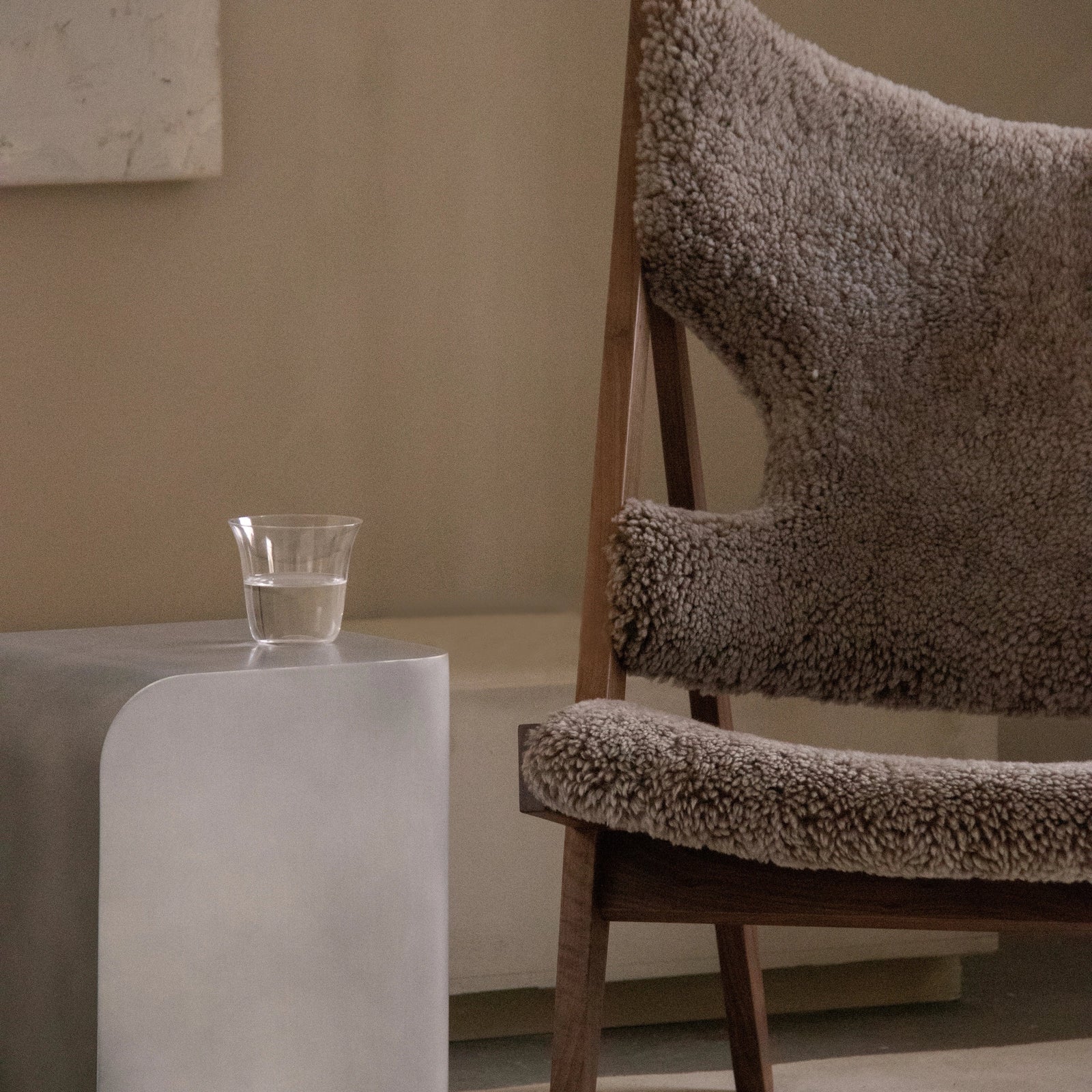
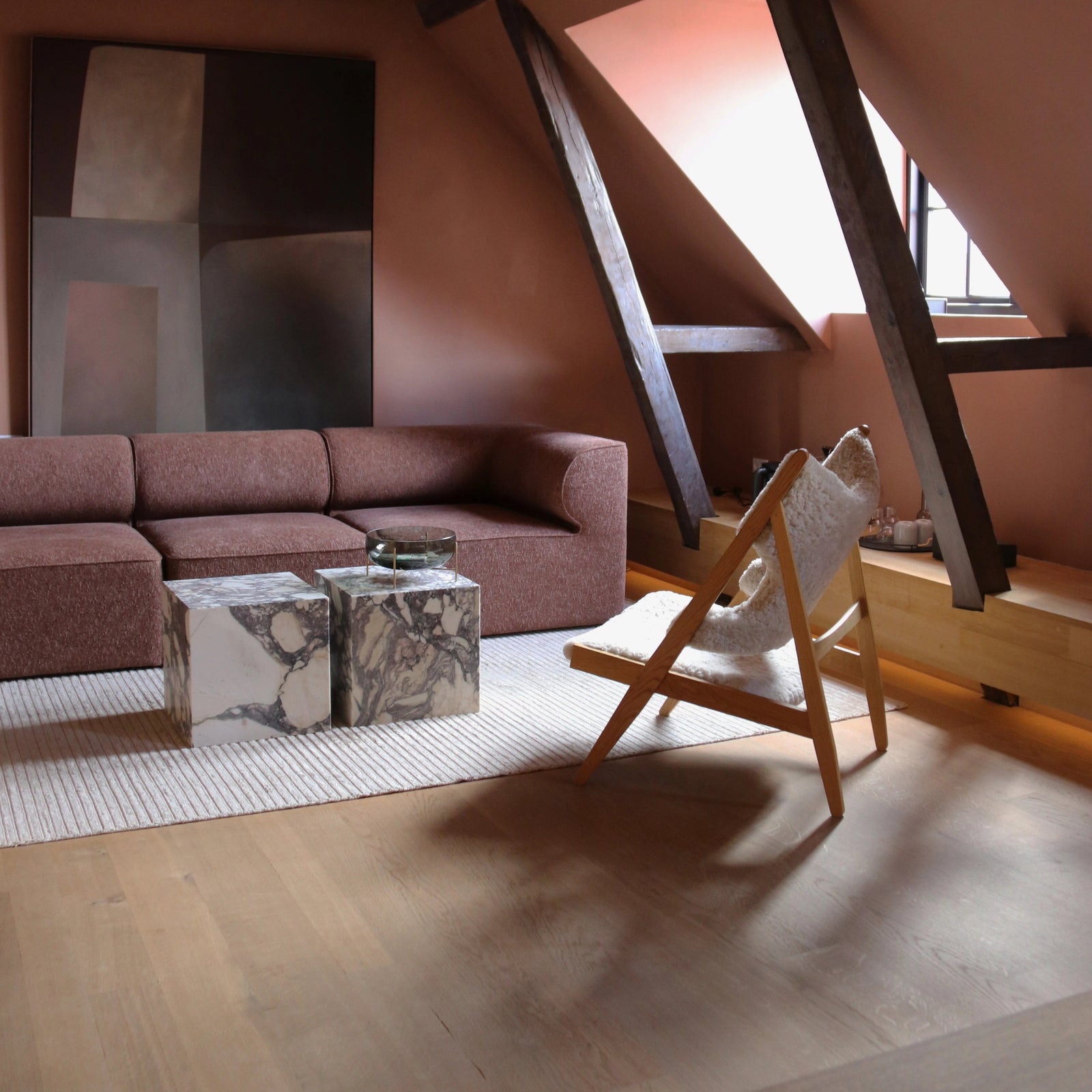
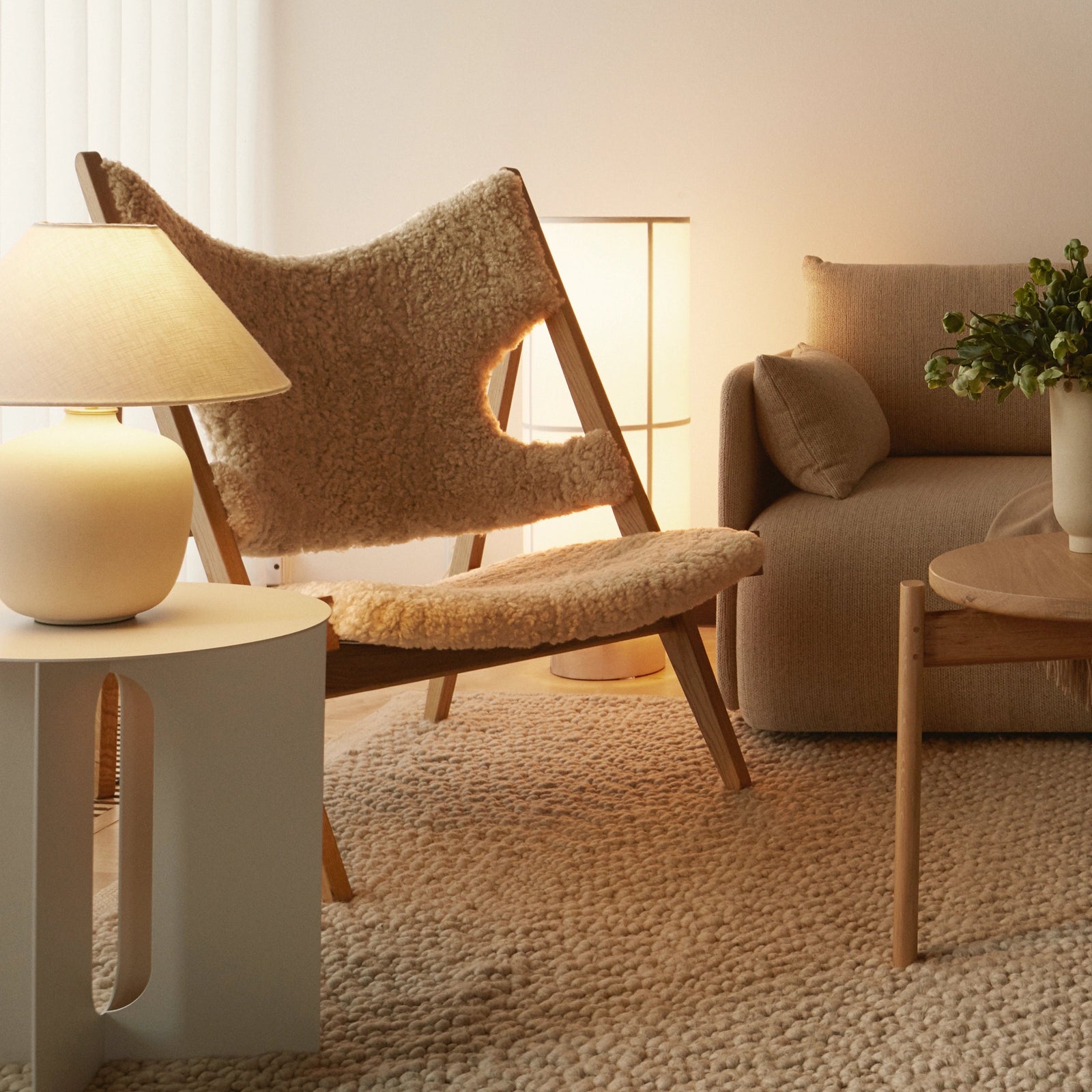
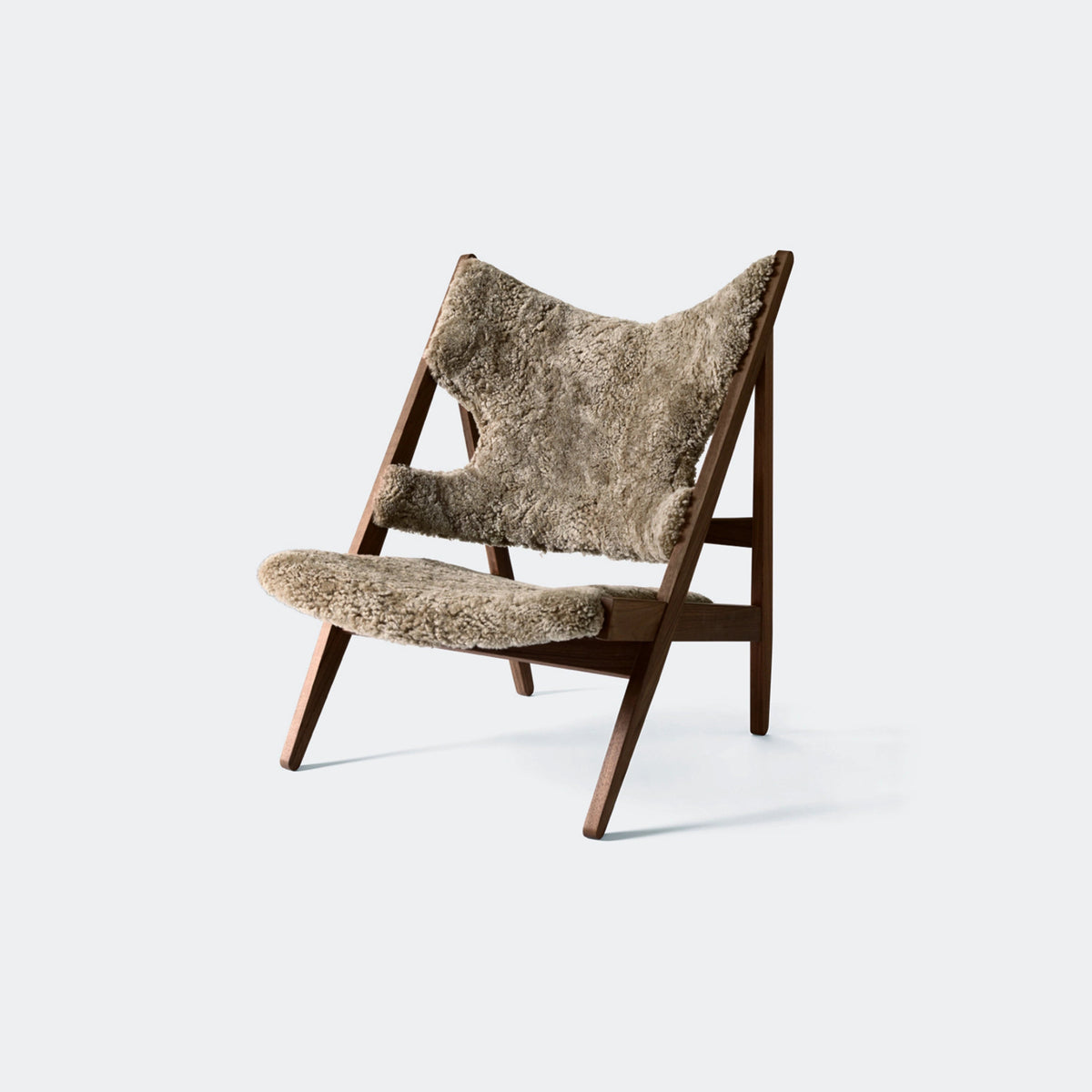
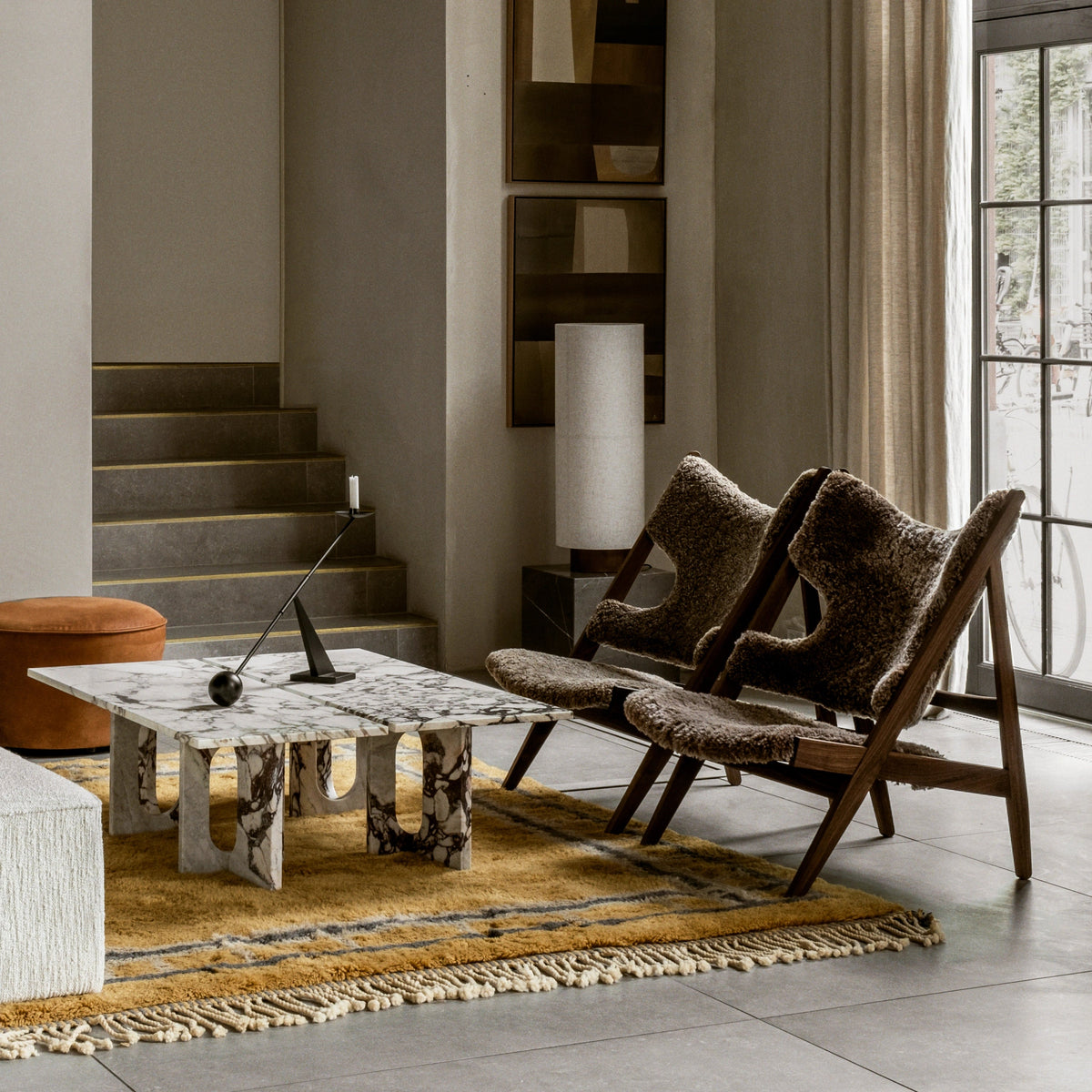
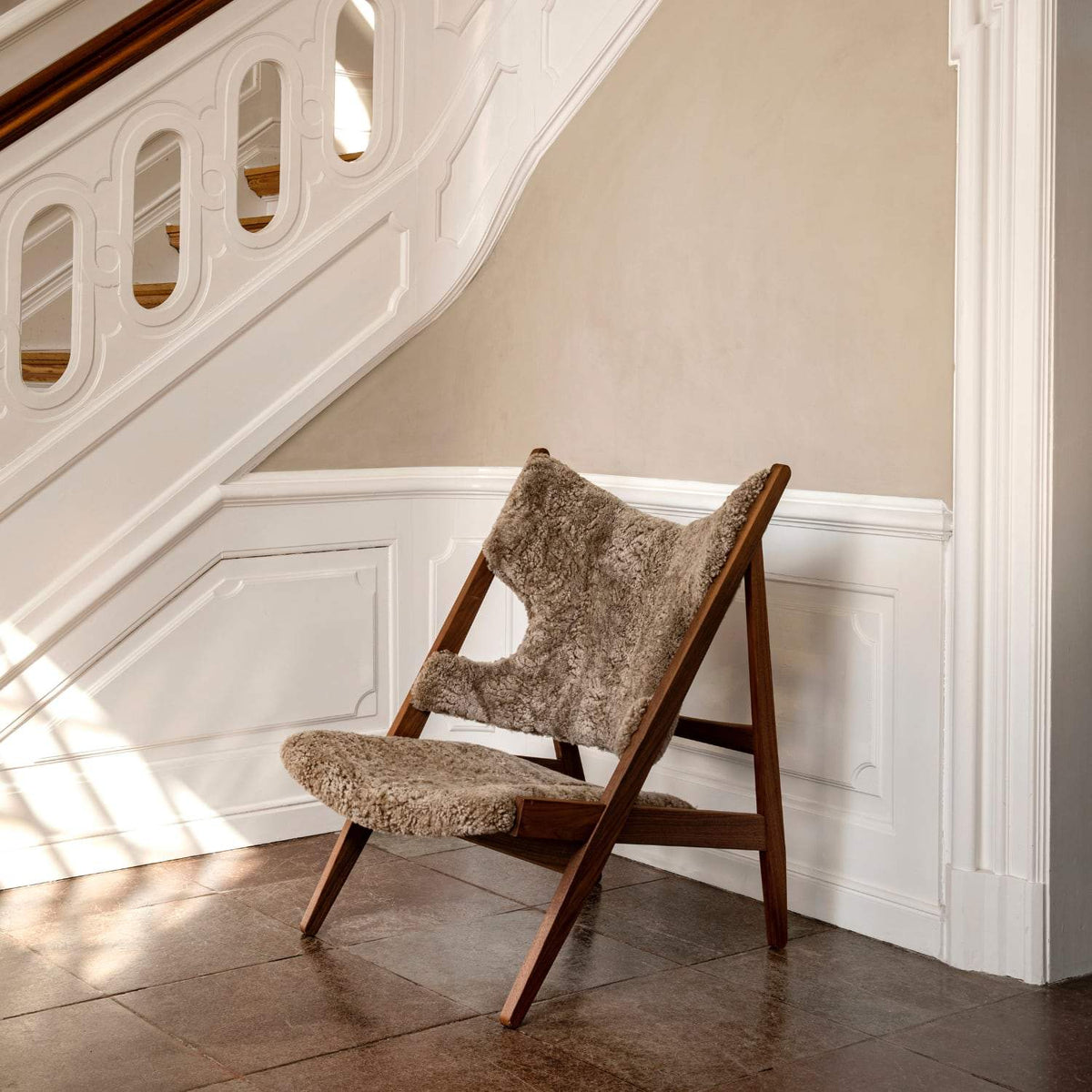
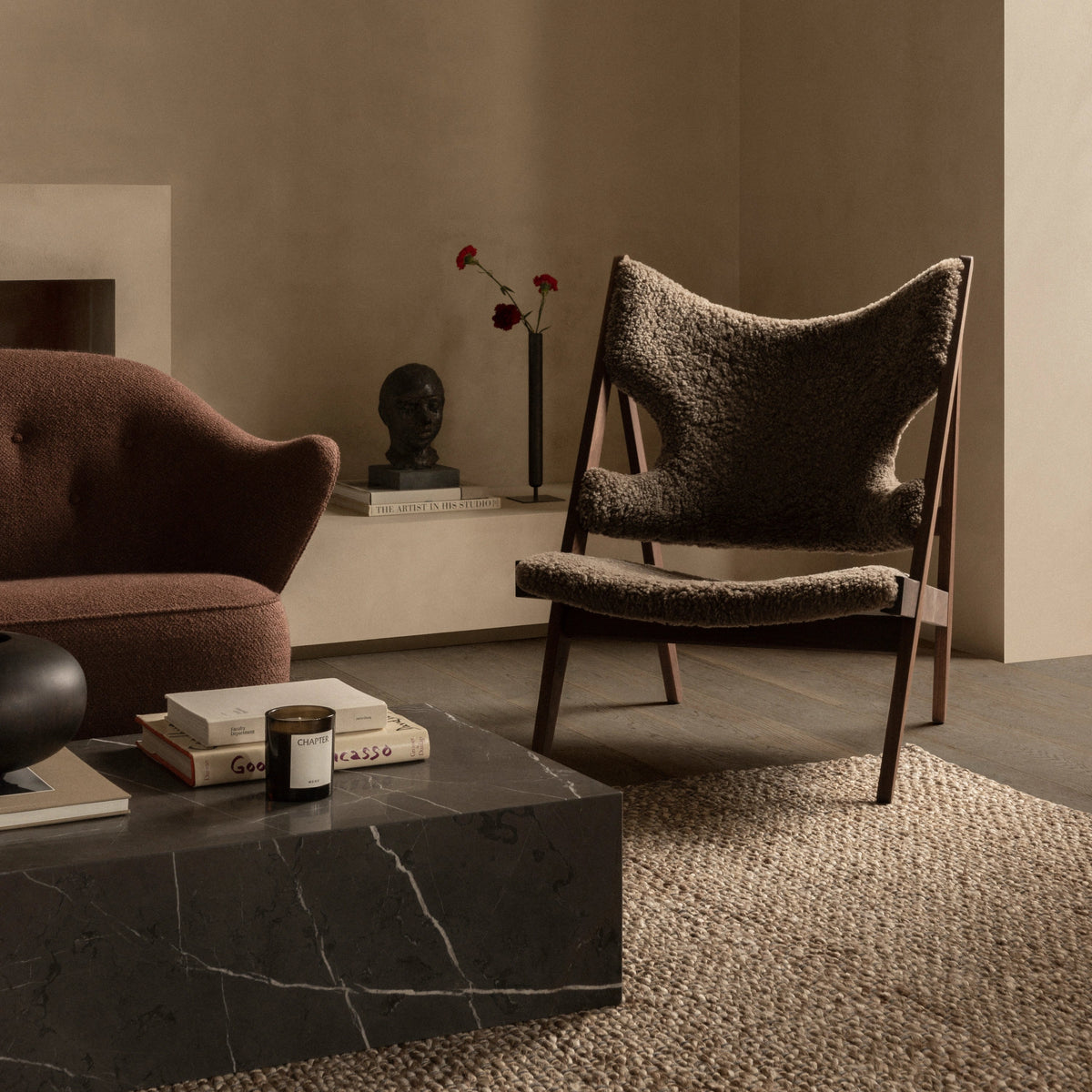
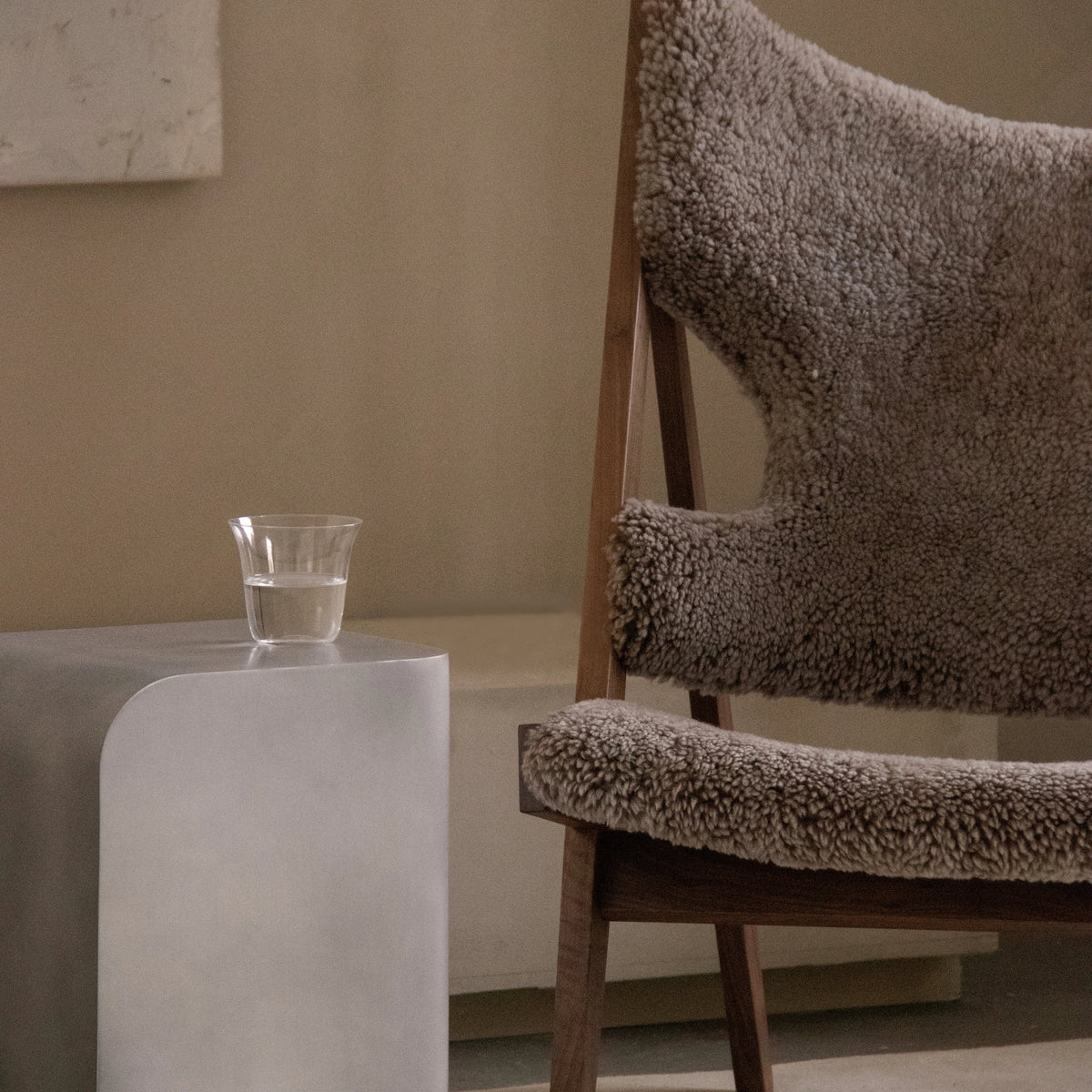
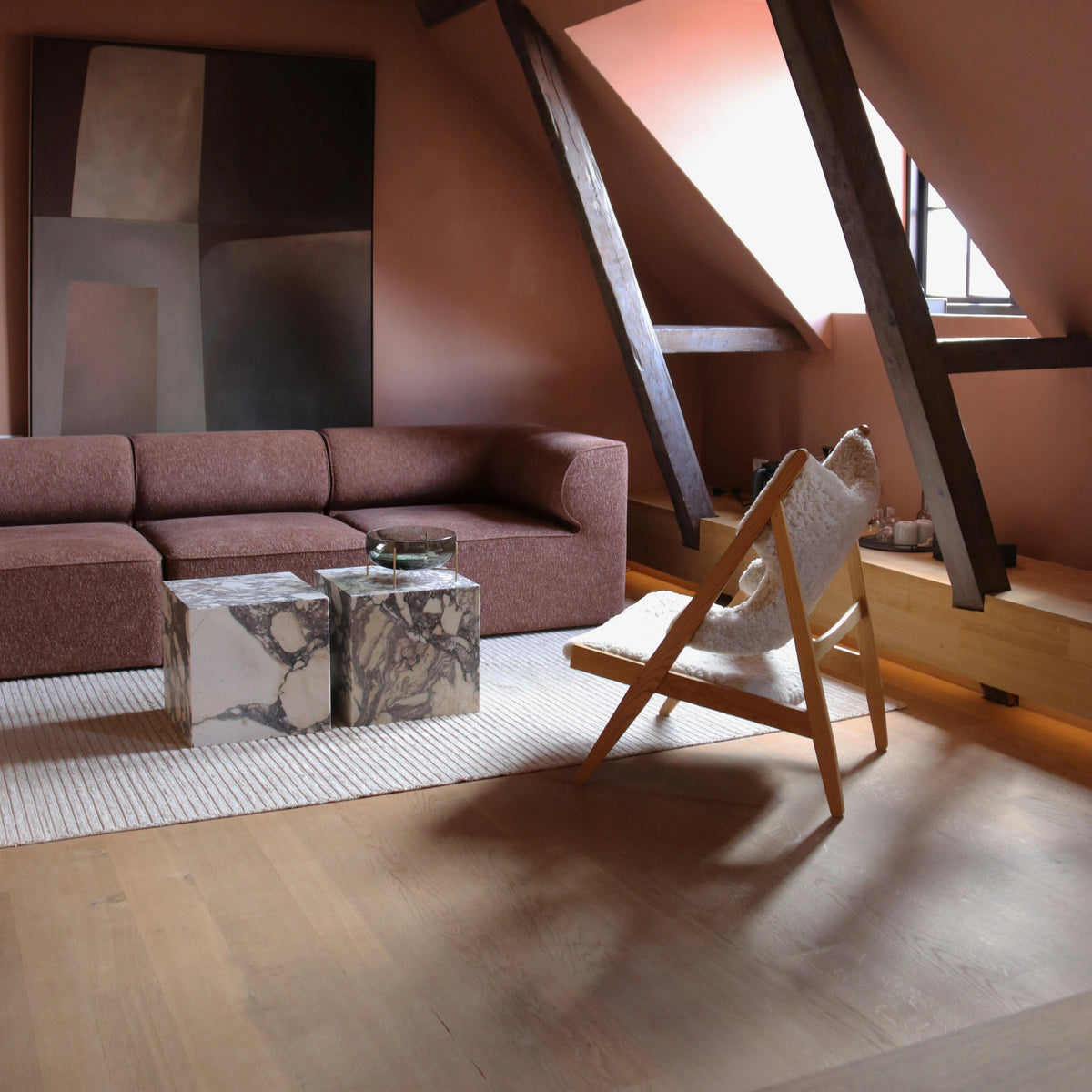
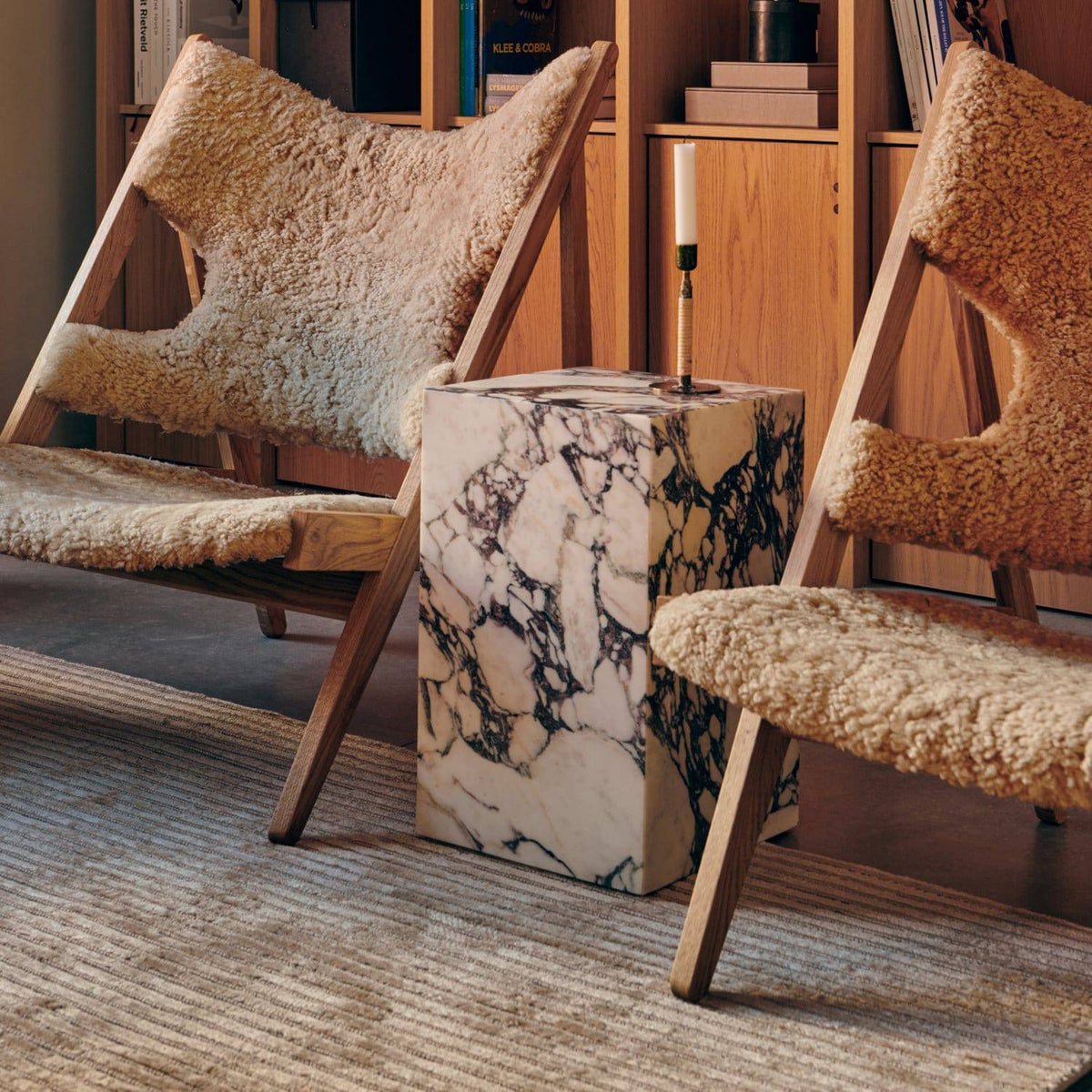
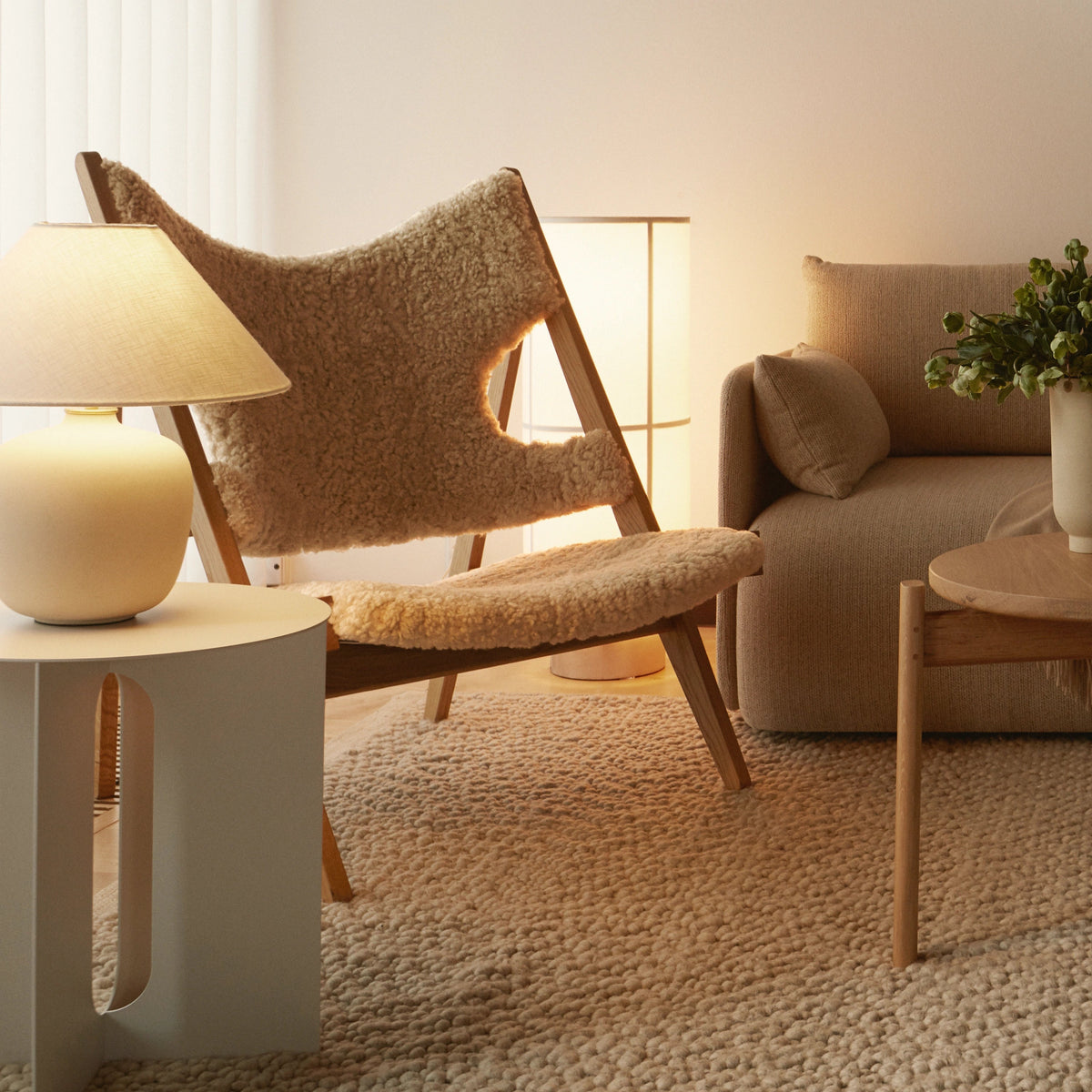
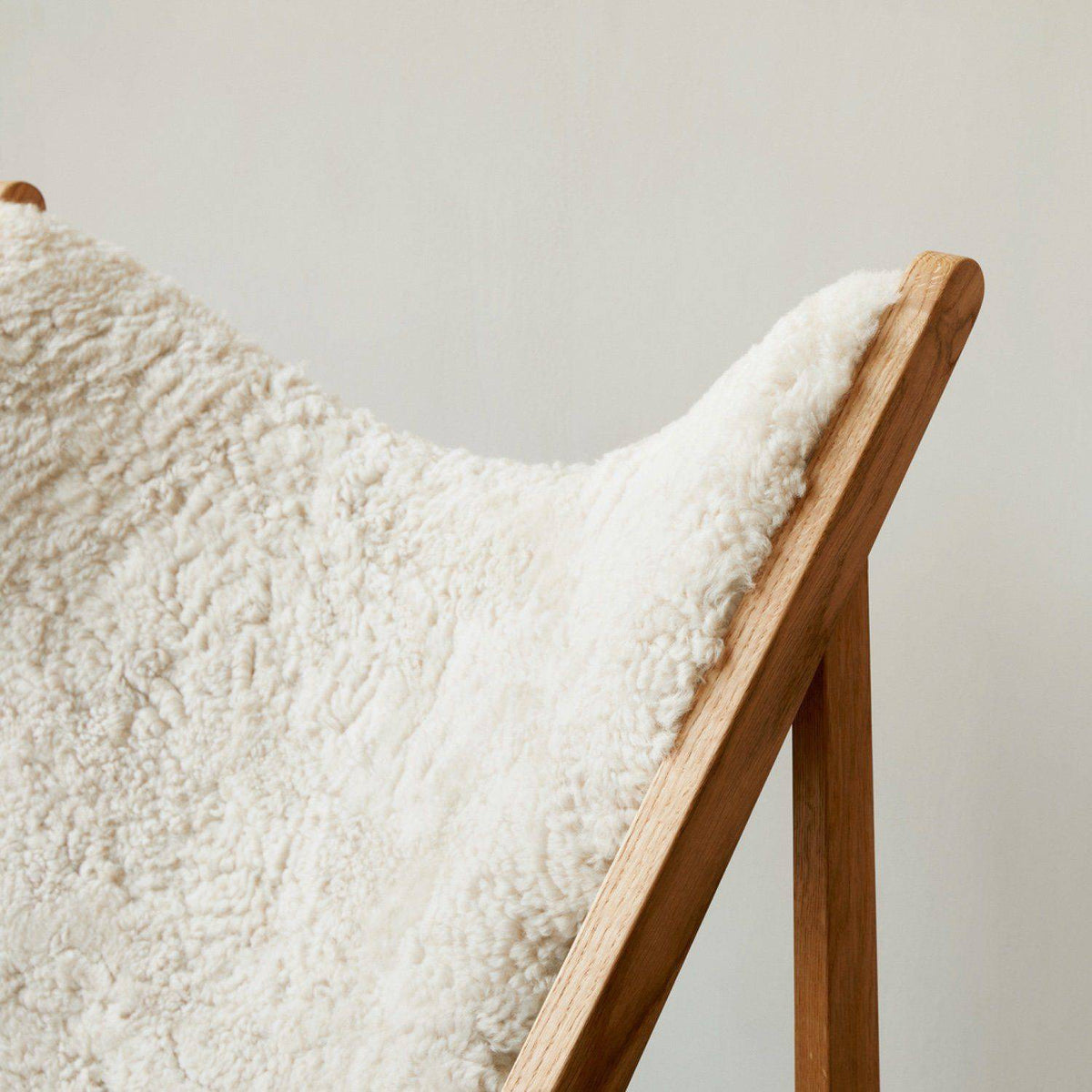
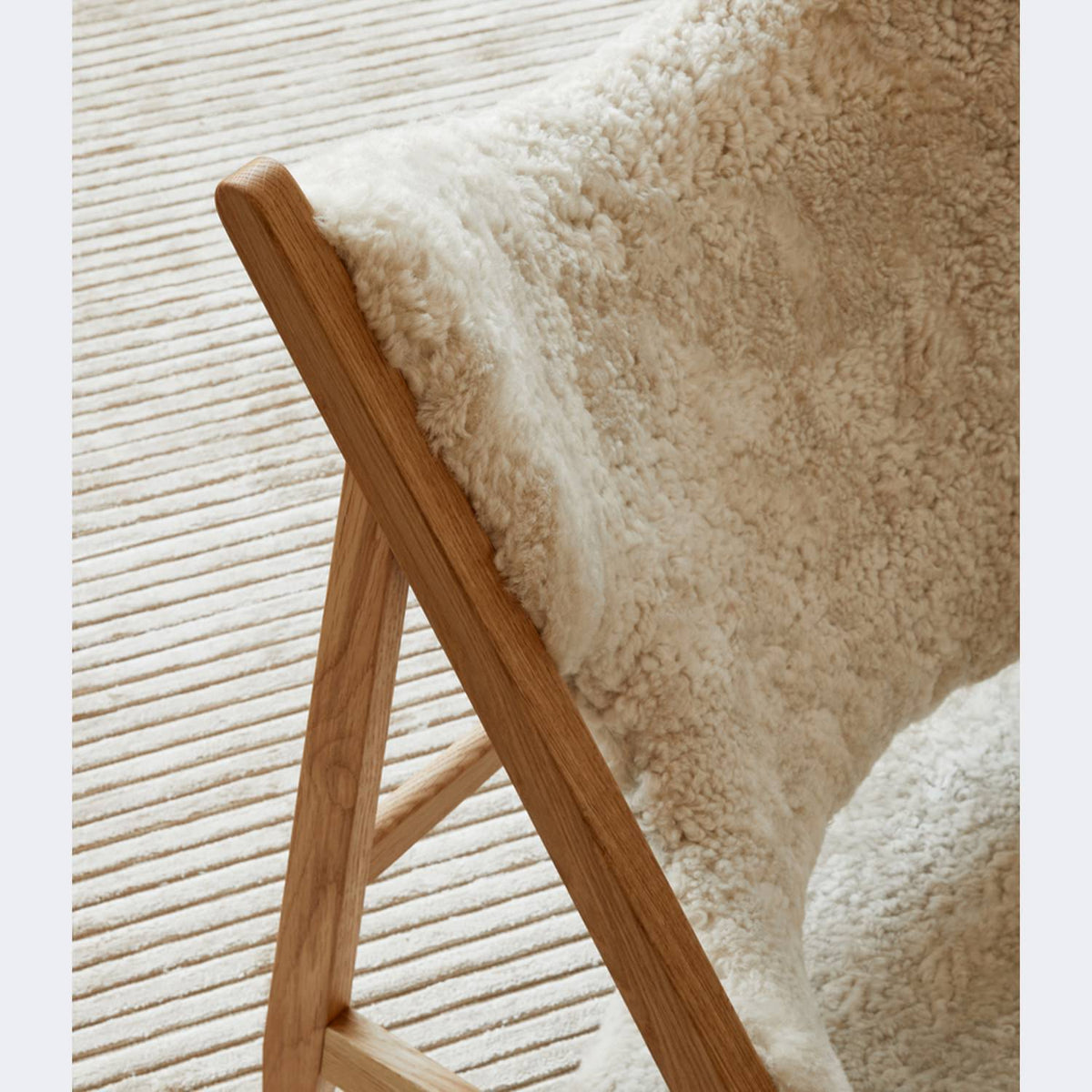
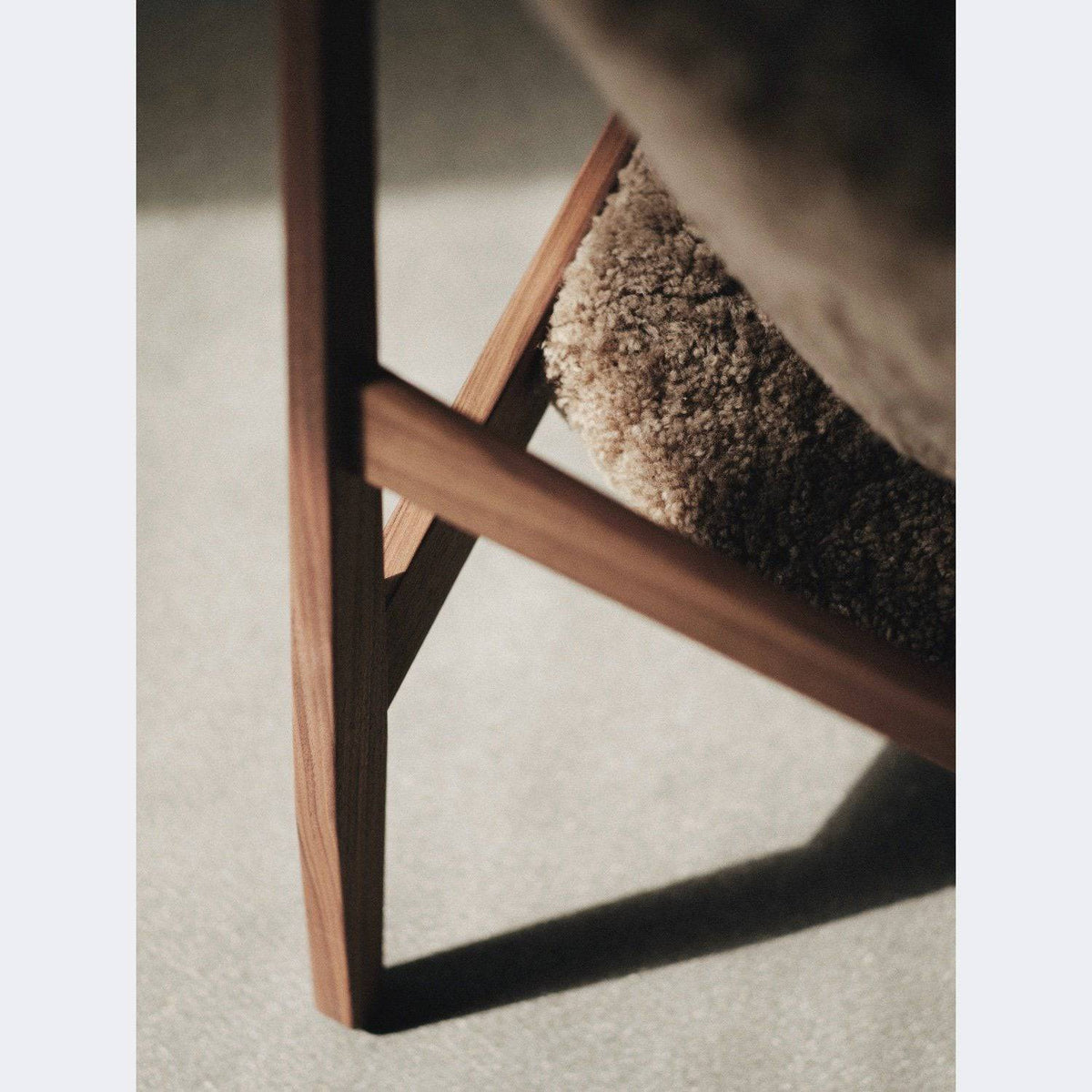
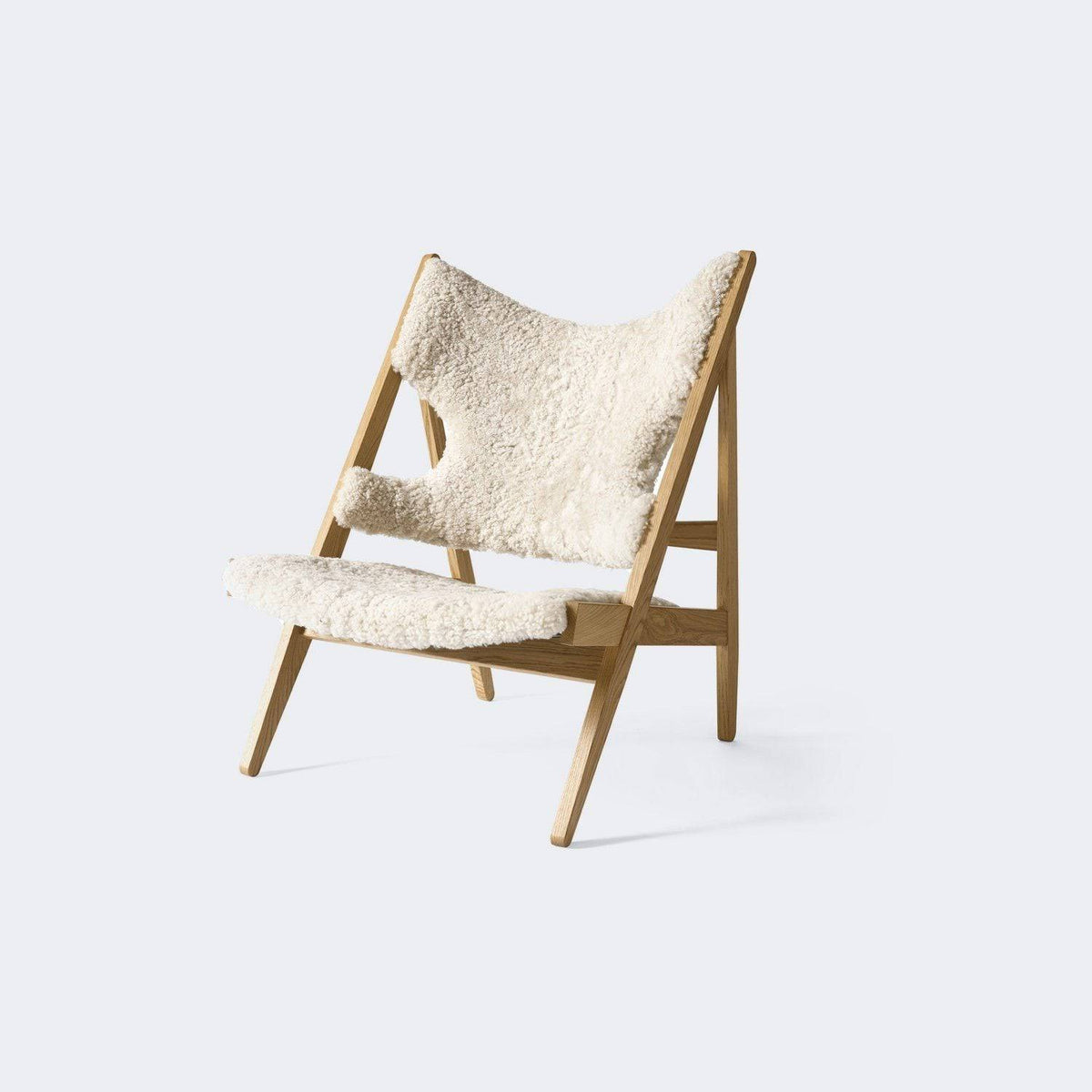
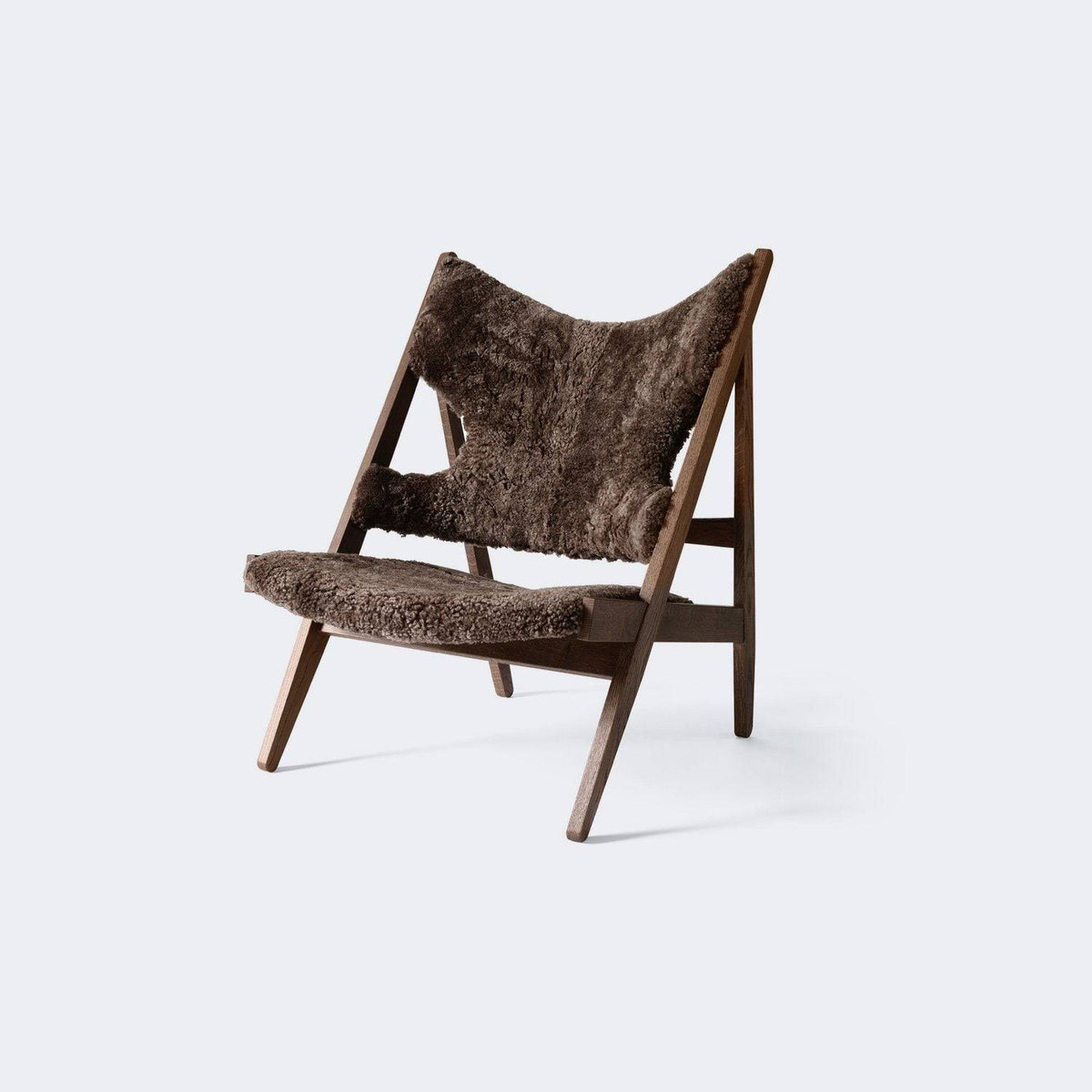
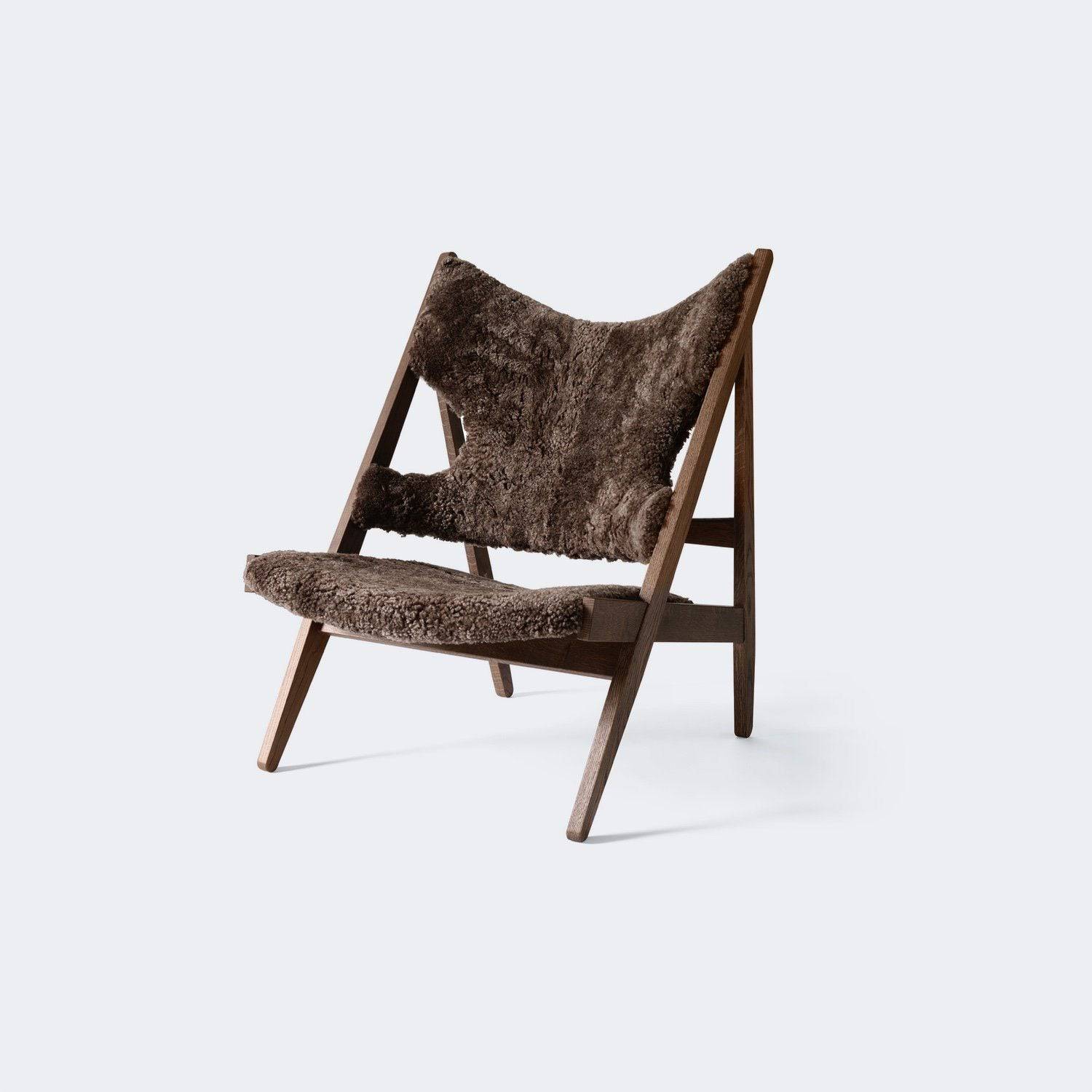
A low lounge chair with broad arms, exposed timber joinery, and elbow cutouts that leave the hands free. Genuine sheepskin deepens its relaxed, tactile seat.
- Genuine sheepskin upholstery
- Elbow armrest cutouts
- Soft-medium seat firmness
28.1" W × 26.3" D × 35.7" H


Authorized Audo Copenhagen retailer · 5-year warranty
Handcrafted for you | Insured delivery by {11-12 weeks}
—
Authorized Audo Copenhagen retailer · 5-year warranty
Description & details
The Audo Copenhagen Knitting Chair, Sheepskin Upholstery, sits low on an exposed triangular oak or walnut frame, wrapped in sheepskin that invites you to sink in and stay. Cut-outs at the elbows keep your hands free, whether that means a book, a tablet, or the needlework that gave the chair its name. Ib Kofod-Larsen designed it in 1951 and showed it at the Copenhagen Cabinetmakers' Guild exhibition that same year, produced then only as a limited edition; Audo Copenhagen now reissues it under Modernism Reimagined, true to the original geometry.
Solid oak or walnut, CNC-milled and wax-oiled, handcrafted in Sweden, in natural oak, dark stained oak, or walnut, with sheepskin in Nature, Sahara, or Root. Its low, compact frame makes a room feel finished without taking it over.
| Dimensions | |
|---|---|
Height35.7 in Width28.1 in Depth26.3 in Seat Height11.8 in Seat Depth16.5 in Arm Height19.1 in | |
| Downloads | |
| Tear Sheet | Download |
Dimension drawing

Specifications
| Materials | |
|---|---|
| Upholstery | Available in fabric, leather, or sheepskin |
| Frame | Solid oak or walnut — CNC milled, wax-oiled finish |
| Base Options | Natural oak, dark stained oak, black oak, walnut |
| Details | |
| Designer | Ib Kofod-Larsen for Audo Copenhagen |
| Made In | Lithuania |
| Seat Firmness | Soft-medium |
| Environment | Indoor |
| Warranty | 5 years |
| Seat & Backrest | Curved plywood with foam, hand-assembled |
| Weight & Shipping | |
| Product Weight | 24.3 lbs (11 kg) |
| Shipping Weight | 29.7 lbs (13.5 kg) |
| Shipping Dimensions | H 37.4" × W 29.5" × D 31.5" |
Dealer verification
Authorized Audo Copenhagen dealer Warranty included
5-year warranty provided by Audo Copenhagen.
Care guide
We recommend avoiding placing furniture in direct sunlight or next to strong heat sources, as this can cause fabrics to discolor.
Day-to-day cleaning:
- We recommend regular cleaning to keep the fabric looking its best and prolong its life. Vacuum gently with a small brush attachment or use an upholstery brush.
- For more pronounced stains, please refer to a specialist cleaner.
Delivery & returns
Shipping
Calculating shipping…
Final rate confirmed at checkout.
White Glove Delivery
Ships from our US warehouse with white glove delivery included. Our team brings each piece to your room of choice, unpacks, removes all packaging, and completes assembly. A signature is required, and no additional fees are due at delivery.
Scheduling
Once your order ships, we contact you by phone and email to arrange delivery, confirming a 4-hour appointment window in advance.
Arrival & Assurance
Every order is fully insured in transit. Inspect each piece with the delivery team and note any damage on the receipt before signing. If you find damage afterward, contact us within 48 hours with photos and we will repair or replace the piece, handling the resolution directly.
Insured delivery
Every order is fully protected against damage, loss, or theft in transit — at our expense, not a service you buy or opt into.
If a piece arrives damaged, note it on the delivery receipt, photograph it, and contact us. If an order is lost or stolen, tell us and we'll replace it. We handle the replacement or refund — you never file a carrier claim or pay return freight. This applies to made-to-order pieces too.
Final Sale
This item is made to order and produced to your configuration, so it cannot be canceled, exchanged, or returned once the order is placed. To order with confidence, request a swatch or speak with our team about dimensions, materials, and finishes before you buy.
Choose options
The Audo Copenhagen Knitting Chair, Sheepskin Upholstery, sits low on an exposed triangular oak or walnut frame, wrapped in sheepskin that invites you to sink in and stay. Cut-outs at the elbows keep your hands free, whether that means a book, a tablet, or the needlework that gave the chair its name. Ib Kofod-Larsen designed it in 1951 and showed it at the Copenhagen Cabinetmakers' Guild exhibition that same year, produced then only as a limited edition; Audo Copenhagen now reissues it under Modernism Reimagined, true to the original geometry.
Solid oak or walnut, CNC-milled and wax-oiled, handcrafted in Sweden, in natural oak, dark stained oak, or walnut, with sheepskin in Nature, Sahara, or Root. Its low, compact frame makes a room feel finished without taking it over.
| Dimensions | |
|---|---|
Height35.7 in Width28.1 in Depth26.3 in Seat Height11.8 in Seat Depth16.5 in Arm Height19.1 in | |
| Downloads | |
| Tear Sheet | Download |
Specifications
| Materials | |
|---|---|
| Upholstery | Available in fabric, leather, or sheepskin |
| Frame | Solid oak or walnut — CNC milled, wax-oiled finish |
| Base Options | Natural oak, dark stained oak, black oak, walnut |
| Details | |
| Designer | Ib Kofod-Larsen for Audo Copenhagen |
| Made In | Lithuania |
| Seat Firmness | Soft-medium |
| Environment | Indoor |
| Warranty | 5 years |
| Seat & Backrest | Curved plywood with foam, hand-assembled |
| Weight & Shipping | |
| Product Weight | 24.3 lbs (11 kg) |
| Shipping Weight | 29.7 lbs (13.5 kg) |
| Shipping Dimensions | H 37.4" × W 29.5" × D 31.5" |
Dealer verification
Authorized Audo Copenhagen dealer Warranty included
5-year warranty provided by Audo Copenhagen.
Care guide
We recommend avoiding placing furniture in direct sunlight or next to strong heat sources, as this can cause fabrics to discolor.
Day-to-day cleaning:
- We recommend regular cleaning to keep the fabric looking its best and prolong its life. Vacuum gently with a small brush attachment or use an upholstery brush.
- For more pronounced stains, please refer to a specialist cleaner.
Shipping
Calculating shipping…
Final rate confirmed at checkout.
White Glove Delivery
Ships from our US warehouse with white glove delivery included. Our team brings each piece to your room of choice, unpacks, removes all packaging, and completes assembly. A signature is required, and no additional fees are due at delivery.
Scheduling
Once your order ships, we contact you by phone and email to arrange delivery, confirming a 4-hour appointment window in advance.
Arrival & Assurance
Every order is fully insured in transit. Inspect each piece with the delivery team and note any damage on the receipt before signing. If you find damage afterward, contact us within 48 hours with photos and we will repair or replace the piece, handling the resolution directly.
Final Sale
This item is made to order and produced to your configuration, so it cannot be canceled, exchanged, or returned once the order is placed. To order with confidence, request a swatch or speak with our team about dimensions, materials, and finishes before you buy.
Questions about the Knitting Chair, Sheepskin Upholstery?
Sourcing a project?
Sign up to become a trade partner with KANSO and enjoy more than just discounted pricing.
From our customers