


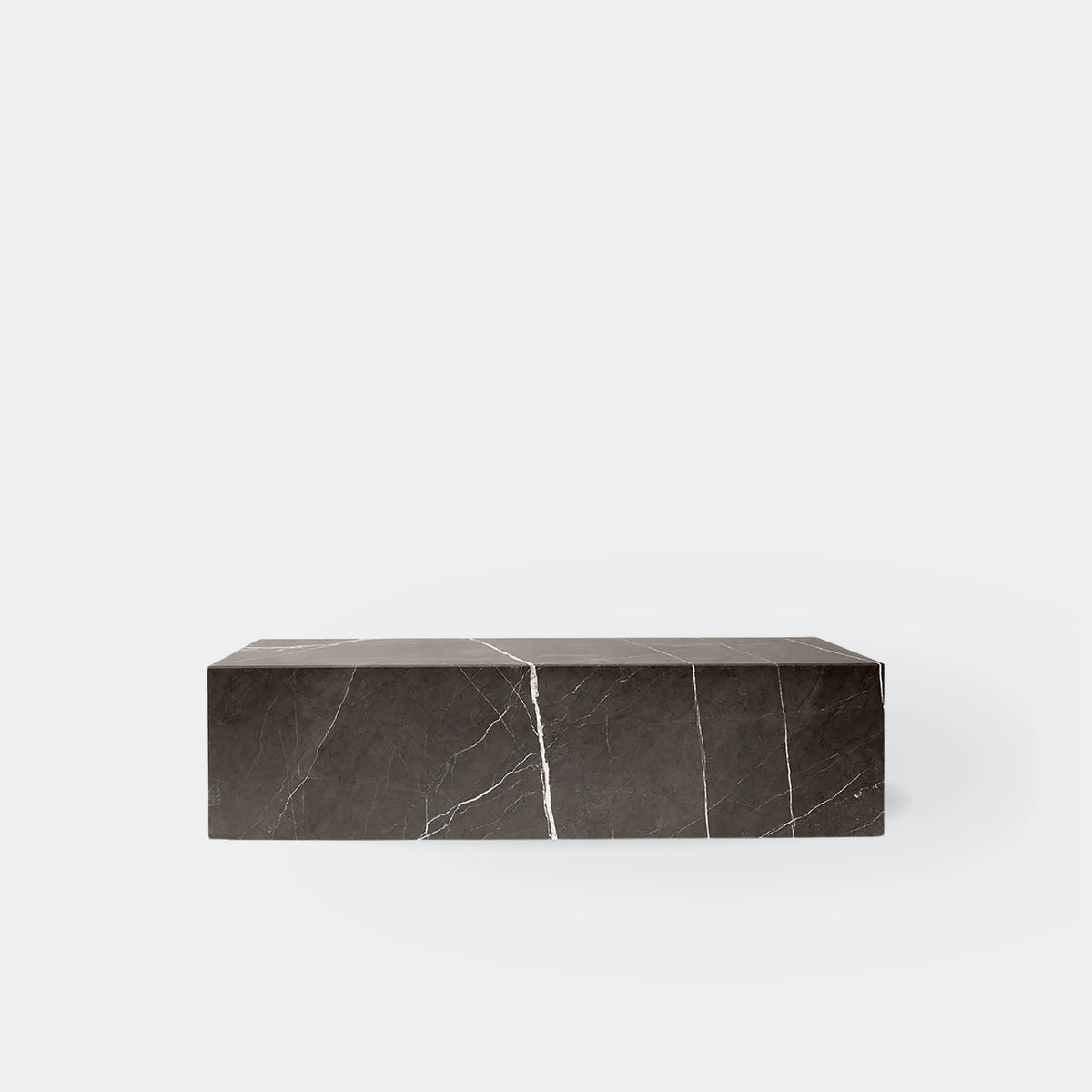
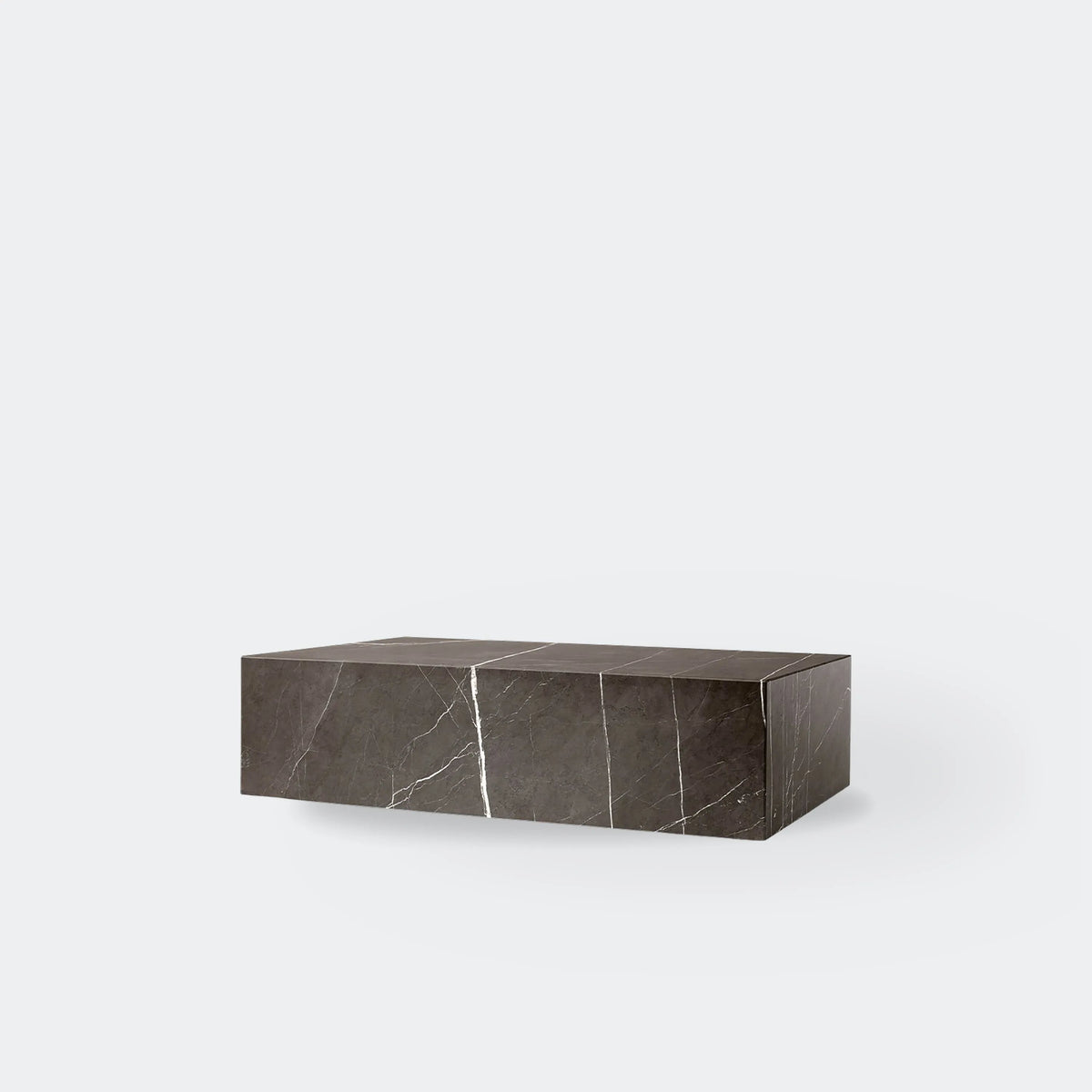
A coffee table assembled from honed marble slabs with mitered corners that make the hollow form appear solid. The non-reflective finish lets light settle across the stone.
- Mitered marble slabs
- Honed matte finish
- Hand-assembled in Portugal
39.4" W × 23.6" D × 10.6" H
Authorized Audo Copenhagen retailer · 5-year warranty
In stock | Free delivery in 5 to 8 days
—
Authorized Audo Copenhagen retailer · 5-year warranty
Description & details
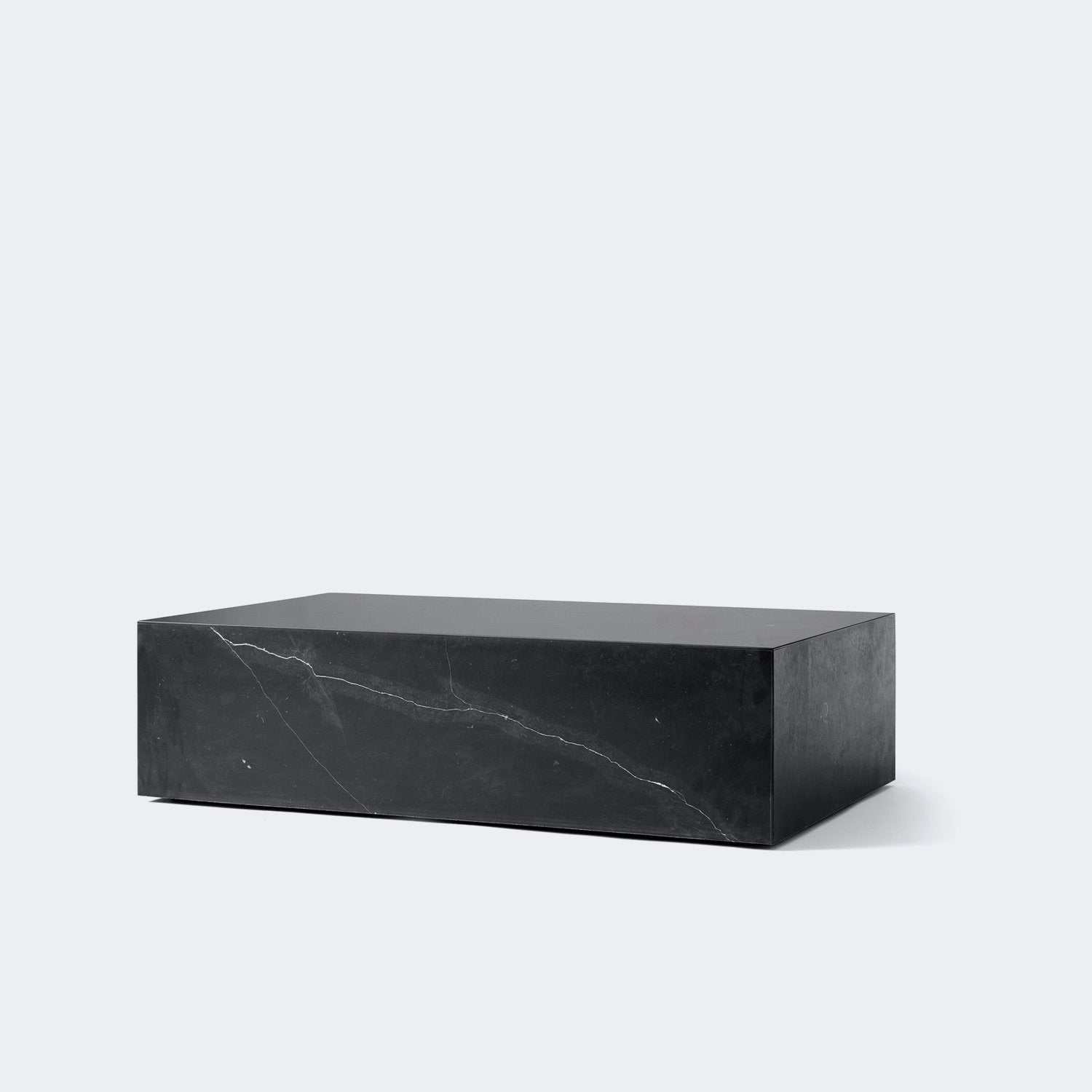
The Audo Copenhagen Marble Plinth Coffee Table is cut from marble slabs joined at mitered 45-degree corners, so the seams disappear and the piece reads as one continuous volume rather than a set of panels. The surface is honed rather than polished, flat and non-reflective, so light doesn't bounce off it but settles across the sharp edges and rests on top, giving the table a quiet, spotlight-like glow. Norm Architects designed it for Audo Copenhagen, part of the wider Plinth collection, made in Portugal.
Five marbles: Nero Marquina, Grey Kendzo, White Carrara, Calacatta Viola, and Kunis Breccia stone, each sealed to guard the surface. Marble is a natural material, so veining varies from piece to piece; no two tables are exactly alike.
| Dimensions | |
|---|---|
Height10.6 in Width39.4 in Depth23.6 in | |
| Downloads | |
| Tear Sheet | Download |
Specifications
| Details | |
|---|---|
| Designer | Norm Architects for Audo Copenhagen |
| Environment | Indoor |
| Certifications | TSCA Title IV compliant |
| Note | Natural stone — veining and color will vary between pieces. |
| Materials | |
| Top & Sides | 2 cm marble or stone — 45° mitered joints, glued and corner-reinforced |
| Stone Options | Carrara marble, Calacatta Viola marble, Nero Marquina marble, Grey Kendzo marble, Kunis Breccia stone |
| Base | MDF with adjustable glides |
| Dimensions & Weight | |
| Weight | 180.8 lbs (82 kg) |
| Shipping Dimensions | H 17.7" × W 43.5" × D 27.8" (45 × 110.5 × 70.5 cm) |
| Ships In | Wooden crate |
Dealer verification
Authorized Audo Copenhagen dealer Warranty included
5-year warranty provided by Audo Copenhagen.
Delivery & returns
Shipping
Calculating shipping…
Final rate confirmed at checkout.
Curbside Delivery
This item ships free by freight in 4 to 6 business days and is delivered to the curb, not inside the home. For room-of-choice delivery, unpacking, and assembly, add White Glove below.
White Glove Upgrade
- $149 — room of choice and packaging removal
- $249 — room of choice, packaging removal, and assembly
Scheduling
We will contact you to schedule a delivery window once your order ships.
Insured delivery
Every order is fully protected against damage, loss, or theft in transit — at our expense, not a service you buy or opt into.
If a piece arrives damaged, note it on the delivery receipt, photograph it, and contact us. If an order is lost or stolen, tell us and we'll replace it. We handle the replacement or refund — you never file a carrier claim or pay return freight.
Final Sale
Because of their size and fragility, large furniture pieces are final sale once delivery is complete. To order with confidence, request a swatch or speak with our team about dimensions, materials, and finishes before you buy.
Choose options
The Audo Copenhagen Marble Plinth Coffee Table is cut from marble slabs joined at mitered 45-degree corners, so the seams disappear and the piece reads as one continuous volume rather than a set of panels. The surface is honed rather than polished, flat and non-reflective, so light doesn't bounce off it but settles across the sharp edges and rests on top, giving the table a quiet, spotlight-like glow. Norm Architects designed it for Audo Copenhagen, part of the wider Plinth collection, made in Portugal.
Five marbles: Nero Marquina, Grey Kendzo, White Carrara, Calacatta Viola, and Kunis Breccia stone, each sealed to guard the surface. Marble is a natural material, so veining varies from piece to piece; no two tables are exactly alike.
| Dimensions | |
|---|---|
Height10.6 in Width39.4 in Depth23.6 in | |
| Downloads | |
| Tear Sheet | Download |
Specifications
| Details | |
|---|---|
| Designer | Norm Architects for Audo Copenhagen |
| Environment | Indoor |
| Certifications | TSCA Title IV compliant |
| Note | Natural stone — veining and color will vary between pieces. |
| Materials | |
| Top & Sides | 2 cm marble or stone — 45° mitered joints, glued and corner-reinforced |
| Stone Options | Carrara marble, Calacatta Viola marble, Nero Marquina marble, Grey Kendzo marble, Kunis Breccia stone |
| Base | MDF with adjustable glides |
| Dimensions & Weight | |
| Weight | 180.8 lbs (82 kg) |
| Shipping Dimensions | H 17.7" × W 43.5" × D 27.8" (45 × 110.5 × 70.5 cm) |
| Ships In | Wooden crate |
Dealer verification
Authorized Audo Copenhagen dealer Warranty included
5-year warranty provided by Audo Copenhagen.
Shipping
Calculating shipping…
Final rate confirmed at checkout.
Curbside Delivery
This item ships free by freight in 4 to 6 business days and is delivered to the curb, not inside the home. For room-of-choice delivery, unpacking, and assembly, add White Glove below.
White Glove Upgrade
- $149 — room of choice and packaging removal
- $249 — room of choice, packaging removal, and assembly
Scheduling
We will contact you to schedule a delivery window once your order ships.
Final Sale
Because of their size and fragility, large furniture pieces are final sale once delivery is complete. To order with confidence, request a swatch or speak with our team about dimensions, materials, and finishes before you buy.
Questions about the Marble Plinth Coffee Table, Low?
Sourcing a project?
Sign up to become a trade partner with KANSO and enjoy more than just discounted pricing.
From our customers